This is one of the foundational techniques of Yagami-Ryū, in its gentle form, Toginawa.
襷 (Tasuki, たすき)
Also referred to as tasuki sabaki, this is the traditional technique for tucking up the sleeves of a kimono using a strip of fabric or a cord.
The video demonstrates this technique in its simplest and most traditional form.
Additionally, the tasuki serves as a back brace that promotes proper posture in the shoulder blade and collarbone area, fostering harmony between the thoracic and lumbar sections of the spine.
The direction shown in the video, from front to back, works exceptionally well for tucking up sleeves and maintaining correct posture over extended periods.
The key is to maintain the proper posture you’ve already adopted, as any forward tilt of the shoulders triggers tension in the upper back, serving as a tactile reminder that encourages the motion of “bringing the shoulder blades together and down.”
I recommend trying this technique for tasks like washing dishes or spending hours at a keyboard. It’s remarkably effective.
In shibari, it’s frequently used as reinforcement and support in structures like the Takate Kote. Typically, it’s constructed with the “third rope” once the basic structure is complete.
It’s not merely decorative but a fully functional technique. Understanding its mechanics and purpose is essential before applying it.
When studying this form, the goal isn’t to mimic the steps or the rope’s appearance but to practice the fundamentals and techniques used in its construction.
Tasuki in Yagami-Ryū
The Tasuki Gote is particularly recommended for exploring the triangle theory, Tetori Sankaku, a body technique (taijutsu) that enables restraint while building a solid and safe structure for the person being tied.
Among rope techniques (nawasuji), this form emphasizes rope handling (sabaku) and the tension between the rope and the body (chōryoku) as a tool for managing the session.
In the Kyūsho-gaku section, non-verbal communication techniques between the person tying and the person being tied are developed, such as body handling through the fascia (fureru).
The Yagami-Ryū is a style rooted in fundamental techniques that combine to create more complex forms.
Thus, mastering the basics is crucial before safely incorporating shibari into erotic interactions.
Creativity and development in this technique will come once it’s fully internalized. I strongly advise against copying applications seen in photos without understanding their function.
Yagami Ren includes a quick demonstration in his YouTube videos of constructing a Takate Kote from a Tasuki, incorporating the arms.
He applies the same technique as in the initial video, from back to front.
For some reason, possibly due to an aesthetic preference influenced by pornography, he encourages the tied person to arch their lower back, which is dangerous in real-world practice.
Video Guide
The video showcases one way to apply this technique to the body.
Remember that both the application and the outcome should be tailored to your interests and the specifics of the moment.
What’s Shown in the Video?
I use the ikue technique, applying the rope folded into four layers instead of the usual two.
I do this for convenience, both for myself (because I’m lazy) and to make it more comfortable for the person being tied, as applying all the rope at once is less bothersome than making two passes, especially in sensitive areas like the armpit.
If you prefer using doubled rope and making two passes, the technique remains the same; it just requires more attention to the direction and intensity of each pass.
Unlike the Japanese video (and Yagami Ren’s), I pass the rope from front to back on both sides, resting it not at the base of the neck but on the latissimus dorsi area (the dorsal region below the shoulder blades).
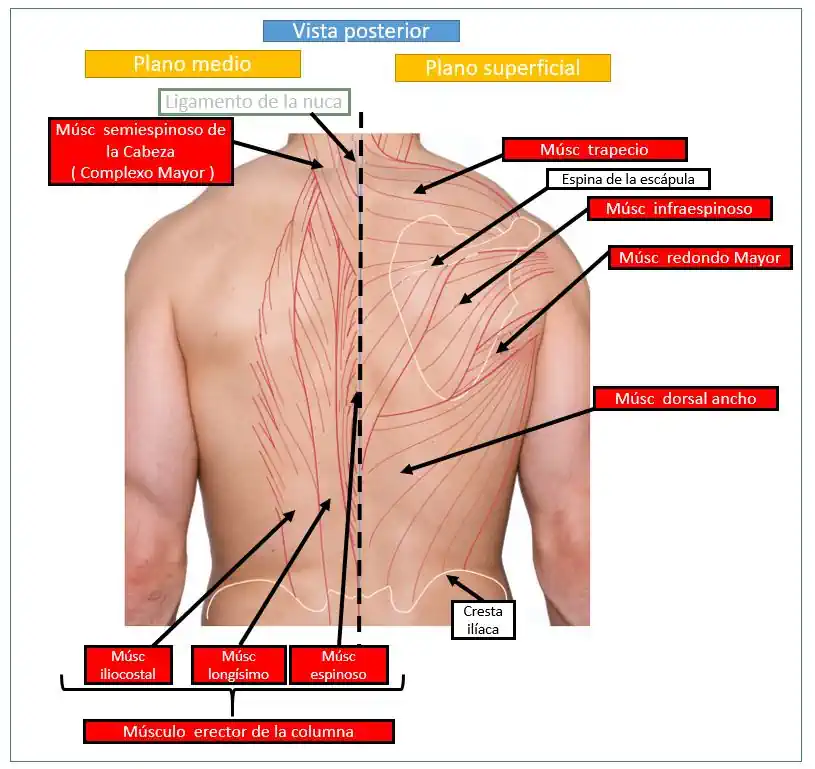
The section of rope that rests on the back (without tightening) acts as a tactile reinforcement, encouraging the kinetic chain formed in the back to “pull” downward and forward, while the kinetic chain from the core to the shoulders “pulls” upward and backward.
These forces balance each other, creating an interesting muscle activation.
When passing the rope backward over the shoulders, the goal isn’t to pull or drag the tied person but to elongate their spine.
The person being tied must respond proportionally and understand what the technique demands of their body.
As a visualization aid, they might imagine carrying a moderately heavy backpack: the ropes over the shoulders represent the straps, and the rope around the back mimics the backpack’s support against the spine.
When the rope passes over the shoulder and descends, a gentle downward force should be applied, more as a cue than a push, until the tied person’s body responds with an upward motion. The concept is push to lift (“push to raise”).
The crossing point, between the shoulder blades, can serve as a tactile cue for the tied person, as we typically have limited proprioception of our back.
Crossing one rope under another brings the tie closer to the body; passing it over moves it farther away.
When closing the tie, the person tying should apply tension only upward to ensure the kinetic circuit created, using the front and back torso muscles, directs all energy toward the back of the shoulders.
This stabilizes the cervical, shoulder, and lumbar joints, protecting the spine during exertion.
The upward adjustment may require slight correction (forward or backward) depending on the tied person’s body placement and balance, similar to how we adjust balance on our feet using the glutes.
Achieving proper tension in such simple ties can be trickier than it seems, so I recommend experimenting with different options until you find what works best.
Uses of This Technique
It can be used as a simple torso harness for floor play or partial suspension, especially for those uncomfortable with restricted arms.
With creativity, it can be expanded to include the arms, creating a gote “in pieces.”
In complex forms like the Takate Kote or Kanuki Shibari, it serves as the third rope.
In these cases, its role is to restore tension in the body or rope lost during tying, providing an adjustment that prepares the body for the demands of suspension.
It also enables better load distribution, facilitating longer suspensions.
If no lifelines or suspension are used, the third rope has no purpose in structures like the Takate Kote.