When an individual encounters a new situation—whether an image, an experience, or a story—they compare it with their prototypes, recognize it, discard it, or, in some cases, slowly modify their own categories. This is simply how we learn.
Categories, however, do not remain isolated inside each person. We share them, discuss them, teach them, and reinforce them—but above all, we turn them into part of our identity.
An individual category helps us interpret the world. A shared category also serves to identify who belongs to the group and who does not.
It stops being merely a cognitive tool and becomes a marker of belonging.
This completely changes the rules of the game. When a category forms part of our identity, questioning it no longer feels like a simple intellectual discussion; it is experienced as a challenge to the community itself.
That is why certain apparently technical debates end up generating disproportionate emotional responses: what is being debated is not only history, but identity.
When several people share the same interpretation, each one confirms the others’ perception.
We do not need everyone to agree. It is enough that most of the voices we hear share the same interpretive framework for us, little by little, to stop perceiving that interpretation as an opinion and to begin treating it as the natural way of understanding things.
It is a silent process. No one announces that the narrative has changed. One day we simply discover that certain questions are no longer being asked.
The Birth of the Narrative
Data exist independently. The narrative establishes relationships between them.
An isolated image of a bound prisoner explains nothing. Neither does another image of an execution, nor a third of a sexual assault.
But when all of them begin to be presented together under the same title—for example, “historical antecedents of shibari”—they cease to be independent documents and start to form a narrative.
And every narrative possesses an enormous organizing power: people remember stories far better than lists of facts.
That is why narratives so easily end up replacing the data.
The Collective Expansion of the Prototype
In a community, each member contributes examples. Every new example is commented on, shared, and validated by others. The prototype then stops evolving solely through personal experience and begins to do so through group consensus.
The community starts building a collective prototype that is not exactly the same as any single member’s. It is the result of thousands of small contributions, each adding a small brick. None is especially important on its own. But over time, they end up constructing an entire building.
When Consensus Replaces Evidence
The fact that many people share an interpretation does not necessarily mean that interpretation is historically correct. Consensus only demonstrates that a group has come to share the same frame of reference.
From inside the community, however, the two phenomena begin to blur. Repetition generates familiarity; familiarity produces a sense of truth.
And what we have seen, read, and heard countless times ends up seeming self-evident—even when the original evidence remains scarce or ambiguous.
This phenomenon is especially intense when primary sources are difficult to consult. Most people do not have direct access to seventeenth-century Japanese manuscripts, nor do they read specialized academic research.
They learn the context through educators, courses, publications, documentaries, or social media. As a result, trust ends up being placed more in those who narrate the history than in the sources themselves.
Here a new figure appears that until now we had barely mentioned: the intermediaries of knowledge.
In any community there are people whose influence far exceeds that of the rest—teachers, authors, event organizers, educators, content creators, and others.
They are not necessarily historians or sources in themselves, but they do act as intermediaries between the sources and the community. The vast majority of practitioners will come to know shibari through them.
This grants them enormous responsibility. But also enormous power.
Because whoever selects which images to show, which examples to cite, and which context to explain is not merely transmitting information. They are constructing the framework from which that information will be interpreted.
We are not talking about bad faith. Every educator selects; every teacher simplifies; every author organizes.
However, when a particular narrative begins to provide prestige, authority, recognition, or economic benefit, some actors stop merely reproducing an existing narrative and begin actively reinforcing it.
We are not claiming that the entire community acts this way. Nor even that most do.
We are focusing on the nature of the process.
When the Narrative Changes
We began this text by asking: How can a representation of an execution end up appearing in an article about shibari?
The answer is not in the image; it is in the narrative. Images, by themselves, barely say anything. They require a context in order to acquire meaning.
A photograph of a person crying can represent pain, joy, emotion, or despair.
A rope can be used to sail, to build a dwelling, to restrain a prisoner, or to engage in an erotic practice.
Meaning never resides exclusively in the object; it arises from the relationship between the object and the framework through which it is interpreted.
That is why the same historical document can acquire very different meanings in different eras. The object remains; the narrative changes. And when the narrative changes, the question we ask of the past also changes.
The Displacement of Context
A historical image is born within a specific context that answers concrete questions: Who created the work? For what purpose? What was happening at that moment? What meaning did it hold for those who contemplated it?
In history, these questions always constitute the starting point. Only afterward can one discuss whether the work maintains relationships with later phenomena.
However, when a community incorporates that image into its own imaginary, the order of the questions can be reversed. The question ceases to be “What does this image represent?” and becomes “What does this image tell us about ourselves?”
The difference seems minimal, yet it entails a profound methodological shift. History stops being studied from the context of the source and begins to be studied from the interpretive needs of the present.
This process rarely occurs consciously. No one decides one day that a medieval execution is going to become an example of shibari. It happens through an accumulation of small displacements.
First a resemblance is noticed; then that resemblance is mentioned; later it is shared, published, cited; other authors reproduce it.
Finally it ceases to be perceived as an interpretation and begins to form part of the intellectual landscape of the community.
That is the truly important moment—not because the object has changed, but because the interpretation the group considers spontaneous has changed.
When the Burden of Proof Changes
Here one of the most interesting transformations in the entire process appears.
The claim “This image forms part of the history of shibari” demands evidence. But when that idea becomes consolidated within the community, the hypothesis begins to function as an assumption.
Then one is no longer asked to demonstrate that the image belongs to shibari; one begins to be required to demonstrate why it should not be considered part of it.
The argumentative burden is inverted, and with it the collective perception of evidence also changes.
The Example of Yoshitoshi and Ito Seiu
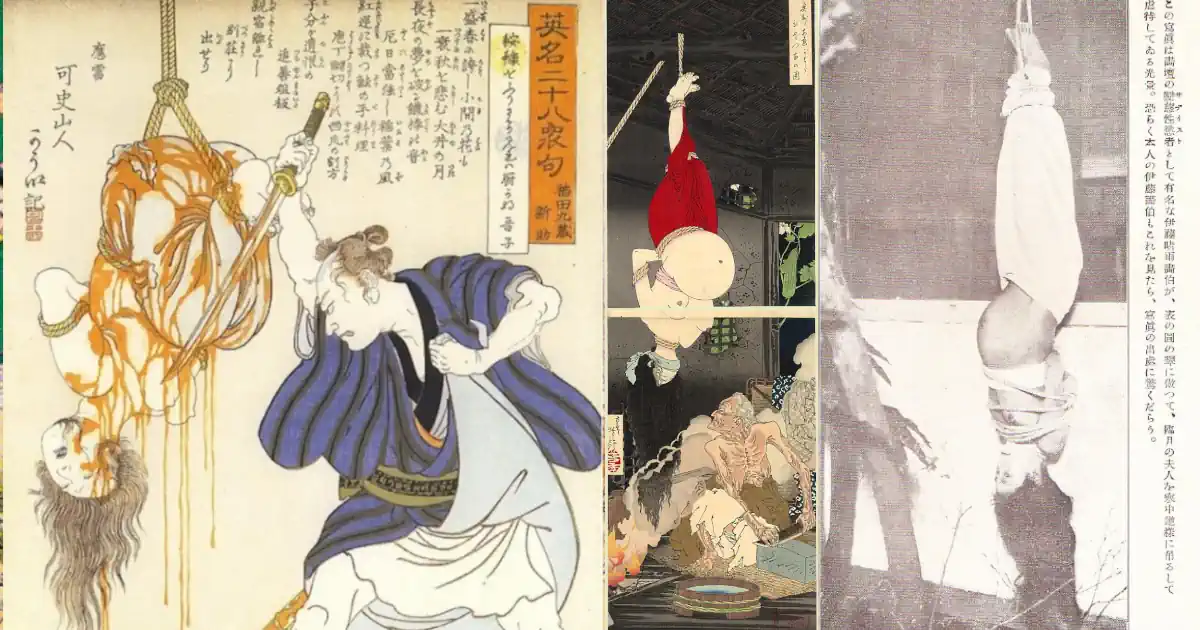
This phenomenon can be observed with particular clarity in a very specific historical sequence.
At the end of the nineteenth century, Tsukioka Yoshitoshi produces one of his best-known prints within the series dedicated to crimes, punishments, and dramatic episodes from Japanese history. The scene depicts a murder. The ropes form part of the crime narrative.
There is no aesthetic intention related to shibari, simply because that category did not yet exist with the meaning we attribute to it today.
Decades later, Ito Seiu contemplates that image and carries out a completely different reinterpretation. He does not attempt to document the crime. Nor does he faithfully reproduce the historical episode.
He uses that composition as raw material to express his own aesthetic, psychological, and sexual concerns. He consciously appropriates an earlier image in order to construct a new artistic language.
This first appropriation belongs to the history of art. It is explicit. It is deliberate. And it is perfectly identifiable.
Almost a century later, however, a third reading appears. A large part of the contemporary community loses interest both in the crime depicted by Yoshitoshi and in the artistic reinterpretation carried out by Ito Seiu.
Both contexts begin to blur. The original scene ceases to be read as a murder; the reinterpretation ceases to be analyzed as a deeply personal work by Ito Seiu. The only thing that remains is the arrangement of the ropes.
The image then comes to illustrate a supposed “historical suspension” or a “technical antecedent of shibari,” thus producing a double decontextualization.
The historical context of the crime disappears, and the artistic context of the reinterpretation disappears. Both works end up absorbed by a third narrative that does not fully belong to either of them.
What is striking is not that this third reading exists—every work admits new interpretations. What is significant is that this reading ends up displacing the two earlier ones until it becomes, for part of the community, the default interpretation.
The Narrative Reorganizes the Past
When an identity narrative gains sufficient force, it stops merely interpreting the past and begins to reorganize it.
Images are no longer grouped by their historical function; they are grouped by their usefulness for the contemporary narrative.
A judicial punishment, an execution, an artistic illustration, or an ethnographic photograph—anything that presents a sufficient visual resemblance begins to be drawn toward the same gravitational center. Not because they necessarily share origin, meaning, or function, but because the new narrative needs to integrate them into a common genealogy.
And the larger that genealogy becomes, the greater the apparent historical depth of the practice—as we saw when addressing the concept of symbolic capital.
Each new incorporation not only expands an iconographic archive; it also increases the perceived prestige of the tradition. Without the need to alter a single historical fact, the narrative manages to produce an impression of continuity far greater than what the sources, considered in isolation, would allow one to sustain.
When the Gaze Changes
There is a still deeper consequence. When the narrative changes, it is not only what we believe we know about the past that changes. What we pay attention to also changes.
And that carries important ethical implications.
Attention Is Never Neutral
Every image contains far more information than we are able to process consciously. Our brain selects. It decides what it considers relevant and leaves the rest in the background.
When a historian looks at a print from the Edo period, they will probably focus on aspects very different from those perceived by an art historian, an anthropologist, or a specialist in costume. All of them contemplate exactly the same work, yet none sees exactly the same image.
Attention is always guided by prior questions, and the questions determine what answers we are capable of finding.
From Context to Technique
Let us return for a moment to the execution with which this essay began.
A historian will probably ask: What crime does it represent? What judicial system does it reflect? What does the sumaki symbolize? What does it tell us about power in medieval Japan?
An art historian may be interested in: the composition; the treatment of movement; the pictorial school; the aesthetic influences.
A person interested in shibari may focus, almost automatically, on another element: the ropes.
Up to this point there is no problem. Specialization always directs attention toward certain aspects. The risk appears when that specialized attention ends up displacing the rest of the image.
The rope ceases to be an element within a scene; the scene begins to become a mere support for observing the rope; and little by little, the historical context loses prominence.
Reinterpreting an image does not necessarily mean justifying what it represents. A researcher may study instruments of torture; a physician may analyze war wounds; an archaeologist may investigate ritual sacrifices.
None of them is legitimizing those acts. They are simply studying them.
In the same way, recognizing that a particular form of immobilization bears technical similarities to later ones does not imply approving the violence in which it arose. The two questions belong to different planes.
We must not confuse historical analysis with moral judgment.