Although reinterpreting does not mean justifying, changing the focus of attention does alter the way we perceive an image.
When we repeatedly look at a scene searching only for certain technical elements, other aspects begin to fade. They do not disappear; they simply stop occupying the center of our perception.
Thus, a representation that originally spoke of justice, punishment, domination, or violence starts to be remembered mainly for the way the ropes are arranged.
The object has not changed. Neither has the image. What has changed is the hierarchy of what we consider important.
And that modification, repeated hundreds of times within a community, ends up producing an unexpected effect.
Moral Neutralization
In criminology there is a concept known as moral neutralization. It describes the mechanisms through which certain behaviors or situations stop being perceived with their full ethical weight and come to be viewed through a different frame.
It does not mean that people approve of violence, or that they intend to justify it. What happens is subtler: violence stops constituting the center of the narrative.
Before: “This image represents an execution.”
After: “This image shows an interesting form of immobilization.”
Notice that the second statement does not deny the first. It simply stops treating it as the most relevant aspect. And what ceases to occupy the center of our attention also ends up losing much of its emotional force.
The image stops functioning primarily as a historical document and begins to function as a visual resource. It is no longer used to understand an event, but to illustrate a contemporary idea.
This explains why certain medieval illustrations appear again and again in articles, courses, or publications dedicated to shibari. Not because they document the origin of the practice, but because visually they prove useful for sustaining a particular narrative about it.
It is an apparently small change, yet methodologically enormous. The source stops speaking for itself and begins to speak the language assigned to it by whoever selects it.
We must not confuse moral neutralization with whitewashing.
Neutralization mainly affects our perception. Whitewashing affects the collective narrative.
It consists of incorporating historically uncomfortable elements into a contemporary cultural heritage by presenting them almost exclusively for their technical, artistic, or identity value.
The violence remains, but it loses prominence. The execution does not disappear; its centrality disappears.
Technique begins to eclipse suffering, and the historical document ends up functioning as a piece of cultural legitimation. Not because anyone has falsified the image, but because the new narrative has reorganized the way that image will be contemplated.
When Context Stops Being the Starting Point
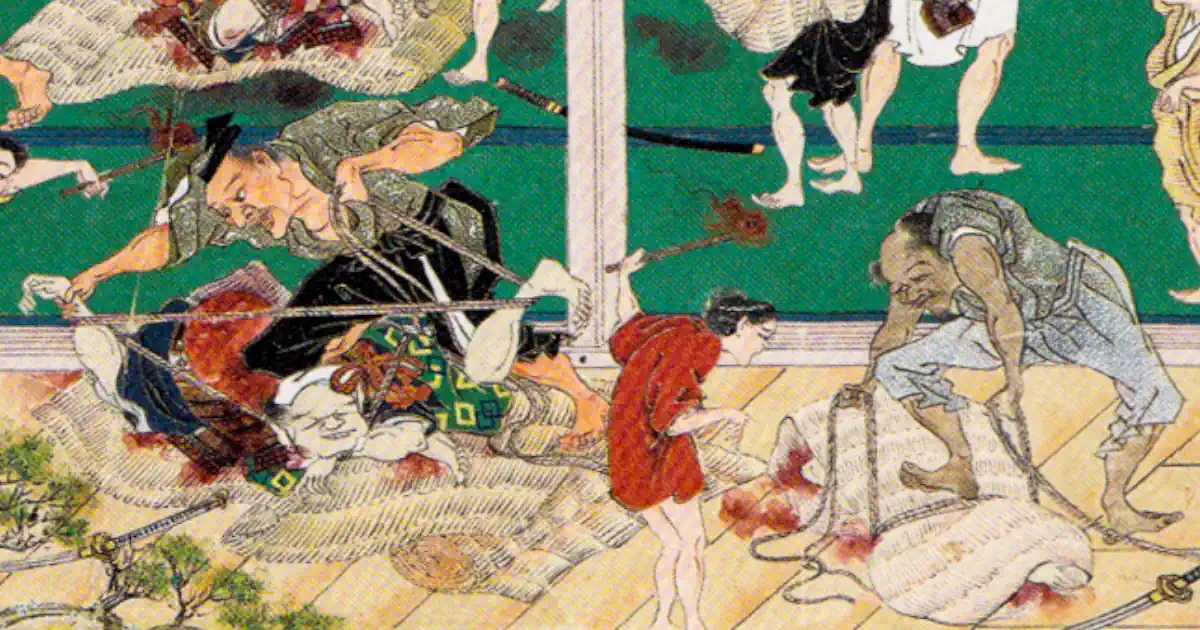
In history and anthropology, context always constitutes the starting point. First we ask what a work meant to those who produced it. Only afterward do we analyze how it has been reinterpreted by later generations.
When this order is reversed, an important methodological risk appears: the historical context is the one that seems to have to explain why that image should not be understood as part of the history of shibari.
The past stops illuminating the present, and it is the present that begins to reorganize the past.
One does not begin by changing the images; one begins by changing what we look at inside them. And when attention changes, interpretation changes. When interpretation changes, the narrative changes. And when the narrative changes, even what a community considers self-evident changes.
When the Narrative Begins to Defend Itself
Until now we have described a process that could occur even if no one deliberately set out to modify history. All of it can arise spontaneously.
Narratives, however, possess an additional characteristic: once consolidated, they tend to protect themselves.
While an idea remains in the realm of knowledge, it can be modified relatively easily. New documents appear, conclusions are revised, errors are corrected. That is how science advances.
But when an idea stops being merely knowledge and becomes part of collective identity, correcting it ceases to carry only an intellectual cost and begins to carry a social cost as well.
Accepting that a widely circulated image does not actually represent what for years was claimed implies far more than correcting a footnote.
It means questioning publications, courses, recognized authorities, and, at times, part of the prestige accumulated by those who constructed that narrative. The greater the symbolic capital associated with a narrative, the greater the resistance to revising it usually is as well.
The Economy of Prestige
Every community generates an unequal distribution of prestige. Some people barely participate; others devote years to teaching, writing, translating, researching, or organizing activities. That recognition is, in itself, legitimate.
What becomes problematic is when that prestige begins to depend on the permanence of a particular narrative.
Whoever obtains authority thanks to a narrative has, consciously or unconsciously, an incentive to preserve it.
And it is enough for some actors to respond to that incentive for it to influence the community as a whole. It is a phenomenon known in numerous fields and can be observed in political movements, spiritual currents, pseudosciences, artistic schools, or national traditions. Whenever a narrative provides status, people interested in conserving it will appear.
When Bias Ceases to Be Involuntary
Biases are inevitable. That is why historical research develops methods aimed at reducing their influence.
Some people, however, learn to recognize those biases and to use them for their own benefit.
Which images generate greater impact, which narratives move people more, which historical references provide a greater sense of legitimacy, which symbols prove more effective at reinforcing the group’s identity.
We are no longer dealing solely with a cognitive process; we are dealing with a communicative strategy. There is no need to invent or falsify. It is enough to systematically select those elements that strengthen a particular narrative and relegate all the others to the background.
The most effective manipulation consists in deciding which documents deserve to be seen and which will remain invisible.
Over time, certain figures acquire a privileged position within the community by acting as reference points. Many practitioners will know the history of shibari exclusively through them, which turns them into a powerful cultural filter with the capacity to decisively influence what the community will come to know as true.
And the less direct access members have to the original sources, the greater that influence will be.
Identity-based communities tend to reinforce their own internal consensuses. The most widely shared publications are usually those that confirm the group’s expectations; discordant interpretations receive less attention. Critical voices find greater difficulty in spreading.
It is not necessarily censorship, but step by step criticism begins to be interpreted not as a methodological disagreement, but as a threat to the community itself.
At that point the debate stops centering on the evidence and begins to center on concepts such as loyalty or belonging, which replace evidence as the main criterion of acceptance. With that, the capacity for self-correction diminishes considerably.
The Inversion of the Burden of Proof
All of this leads to a consequence we had already anticipated. Once the narrative reaches sufficient stability, the community stops asking: “What evidence supports this interpretation?” And begins to ask: “Why would someone want to question it?”
The focus no longer falls on the sources. It falls on whoever introduces the doubt—their motivations, their belonging to the group.
The discussion progressively abandons the terrain of evidence and shifts toward the terrain of persons. It is one of the clearest symptoms that a narrative has acquired an identity function.