There is a deeply human reason why these processes are so difficult to reverse. Ambiguous categories generate discomfort. Our brain prefers clear answers: yes or no.
Reality, however, rarely works that way. Most knowledge inhabits precisely those grey areas.
Accepting uncertainty demands constant cognitive effort and a good measure of humility. It is far simpler to expand a category indefinitely until everything seems to fit than to accept that some images will always remain in an uncertain position.
Paradoxically, critical thinking does not consist in classifying more and more things. It often consists in resisting the urge to classify them too quickly.
Discarding quickly produces calm. Provisionally suspending judgment produces knowledge.
Only when a category retains the capacity to exclude does it also retain the capacity to explain. And only when a community accepts that some of its narratives may be wrong does it keep intact its capacity to learn and grow.
When a Rope Stops Being a Rope
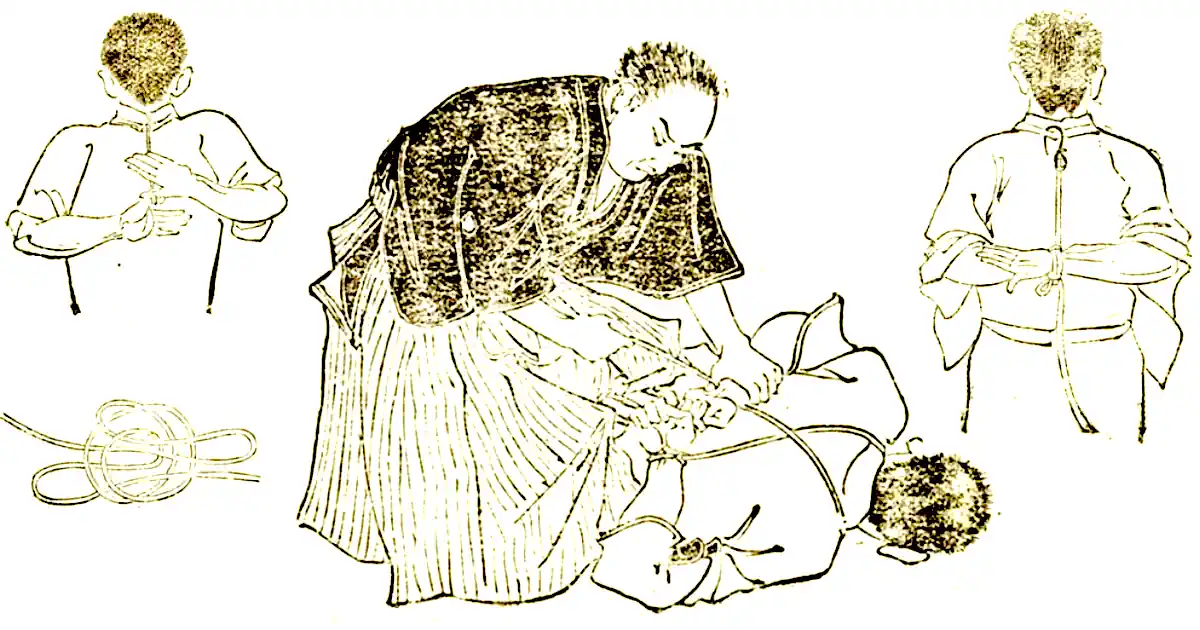
This article does not attempt to answer what shibari is, or to establish a definitive definition of its historical or cultural limits.
It tries to understand how a community comes to construct a narrative about itself, and how that narrative can progressively modify the way it interprets images, the past and, ultimately, its own identity.
It is a process that does not begin with conscious manipulation. It starts in the way the brain categorizes reality, continues when those categories are shared socially, and consolidates when they provide identity and symbolic capital.
It is then reinforced—this time deliberately—by those who find in that narrative a source of prestige, authority, or legitimacy.
These mechanisms are not exclusive to shibari. They appear wherever a community needs to explain its origin, justify its existence, or reinforce the value of what it considers important.
The case of shibari is especially interesting not because it is unique, but because it allows many of these processes to be observed with unusual clarity.
The relative scarcity of sources, the importance of iconography, the strong identity charge of part of its community, and the coexistence of cultural, economic, ideological, and sexual interests make this field an excellent area of study for how collective narratives are constructed.
Precisely for that reason, however, it also demands an especially rigorous methodological effort. Every time a historical image is incorporated into a contemporary genealogy, it is worth asking a simple question.
Not: “Does it look like shibari?”
But: “What did it mean to those who created it?”
Only afterward is it legitimate to ask whether there are relationships with later practices. Inverting that order means allowing the present to reorganize the past.
And when the present reorganizes the past, the risk is transforming the ethical meaning of what we contemplate. An execution can become a pose, or an instrument of punishment a technical resource.
Not because the image has changed, but because the story we tell about it has changed. Images retain their material existence; the brushstrokes remain exactly where they were four hundred years ago. The only thing that changes is the narrative.
And yet that change is enough to alter what we believe we are seeing.
At that point, the true object of study ceases to be shibari and becomes our own mechanisms of interpretation.
Because every community needs narratives, but no community should place those narratives above the sources it claims to preserve. History does not exist to confirm our identities. It exists, precisely, to put them to the test.
Accepting that discomfort is one of the most demanding forms of intellectual honesty.
To think critically consists, above all, in retaining the capacity to question those stories we would most like to be true. So perhaps we return, one last time, to the image with which this essay began.
We will still see ropes. We will still see a person immobilized. But perhaps we will also recover something that the narrative had slowly been pushing toward the margins.
We will see an execution, a revenge, a society different from our own, represented in a work created to speak of violence, power, and punishment.
And only when we are able to see it first as it was, before asking what it can mean for us, will we be doing history.
The Mirror and the Window
There is an old temptation in every investigation of the past: to believe that we are studying history when, in reality, we are looking for ourselves.
It is a deeply human inclination. We need to feel that what we do today has ancient roots, that it forms part of a tradition, that others walked the same path before us.
But when we stop using the past as a window through which to understand different societies and begin to use it solely as a mirror in which to contemplate our own ideas, we stop asking what those images really meant to those who created them, and we care only about what they can say about us.
And, almost without noticing, the past ceases to be a territory to explore and becomes a storehouse of arguments.
Works cease to be documents; they turn into proofs. Historical figures cease to belong to their time and begin to work for ours.
We start filling their silences with our own expectations. And the stronger our identity, the harder it becomes to distinguish between what the sources actually say and what we would like them to say.
That is why critical thinking demands an uncomfortable attitude: accepting that some questions have no definitive answer, that certain images will remain ambiguous, and that, at times, the most honest conclusion consists precisely in recognizing that we do not know.
Not every resemblance implies continuity. Not every tradition needs to stretch back centuries in order to possess value. Not every contemporary practice gains legitimacy by finding a remote antecedent.
Just as not every image that contains ropes speaks of shibari. Sometimes it simply speaks of violence, punishment, crime, or suffering.
Respecting that context does not diminish the value of contemporary shibari. On the contrary, it frees it from an unnecessary need: the need to justify itself by appropriating stories that never belonged to it.
It is enough to understand it for what it really is—with its lights and its shadows, with its documented history and with its uncertainties. Accepting that possibility requires giving up part of the comfort that grand narratives provide, but it allows us to recover something far more valuable: the capacity to be surprised.
And perhaps that is the most important lesson a simple rope leaves us.
Not everything that binds unites.
Sometimes it can also limit the way we look.