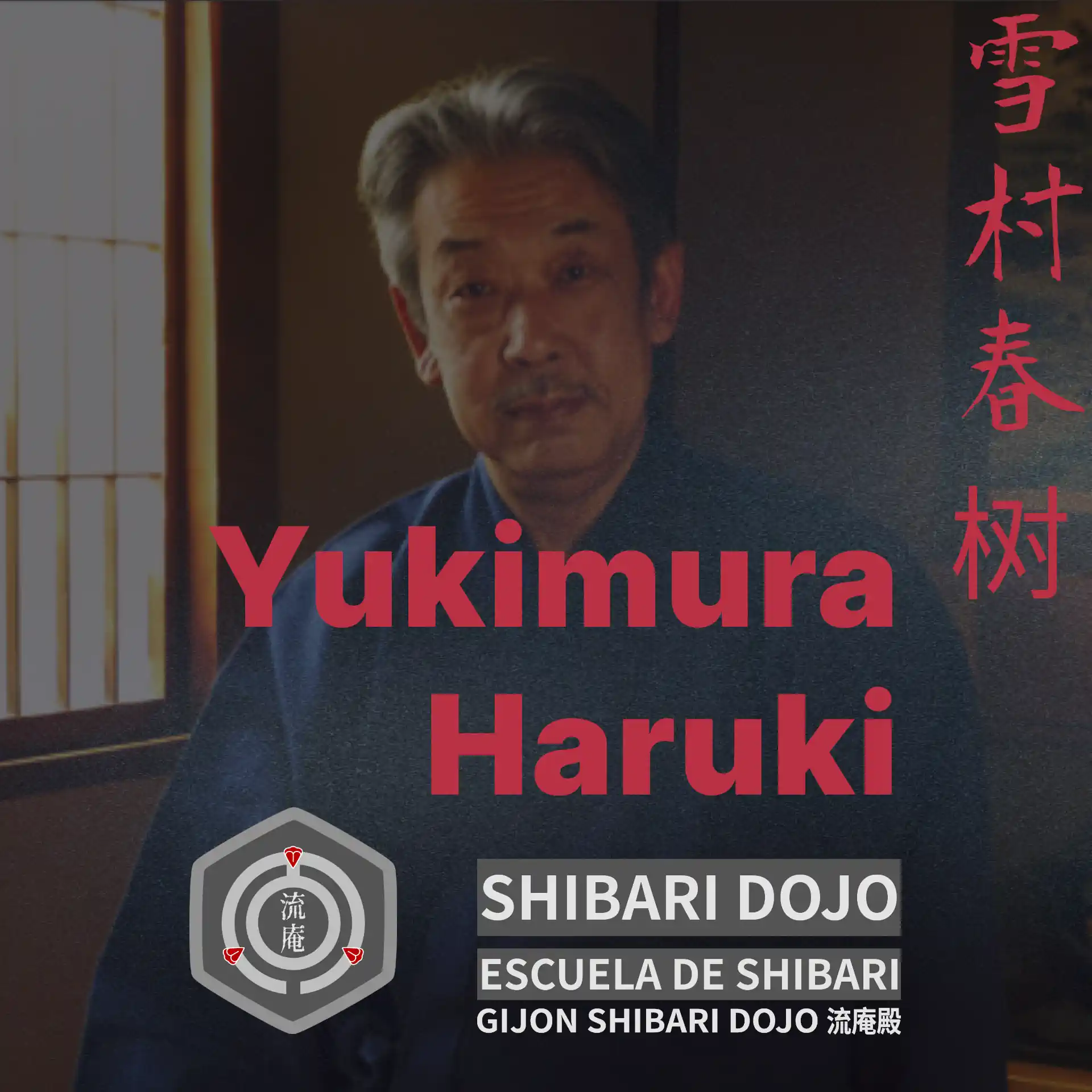
Actualizado → January 28, 2026.
Haruki Yukimura (雪村春树, 1948–2016) was, without question, one of the most influential, prolific, and singular Japanese rope artists of his time.
A photographer, reggae musician, performer, audiovisual producer, and kinbaku master, he spent more than three decades honing his craft—fundamentally transforming how Japanese shibari was perceived, both domestically and abroad.
His intimate, emotional, and deeply human approach made him a touchstone within the field, and his legacy continues to live on through his students and an extensive visual archive.
Born on May 11, 1948, in Hyōgo Prefecture, Japan, Yukimura was raised in the Kansai region. This upbringing left him with a distinct Osaka accent—something many recall as inseparable from his personality: direct, ironic, and warmly approachable.
The Osaka dialect (Osaka-ben) is often described as blunt, expressive, and lively, closely tied to humor and the open, outgoing nature of the region’s people. Compared to standard Tokyo Japanese, it sounds more melodic yet rougher in tone, and it remains a hallmark of Japanese comedy, commonly associated with lighthearted or informal characters.
From an early age, Yukimura showed a deep interest in the audiovisual arts, along with a fascination for bondage and its place within the Japanese imagination—particularly as depicted in historical period dramas scenes of restraint.
Before fully devoting himself to kinbaku, Yukimura began his career as a professional photographer, spending several years working across various fields.
During this period, he developed a strong technical foundation and a refined eye for composition, framing, and the emotional expression of the human form.
In his thirties, he turned his focus to erotic photography, a field that allowed him to explore themes of intimacy, vulnerability, and desire more freely.
In 1982, he began collaborating as a photographer with S&M Sniper, one of Japan’s most influential SM magazines at the time.
At first, rope work was merely one aspect of his visual repertoire. Gradually, however, it took center stage. What began as a visual device evolved into the core of his artistic expression.
By the mid-1980s, with the emergence of new video formats, Yukimura expanded his work into the audiovisual medium.
In 1986, he permanently adopted the artistic name Haruki Yukimura (雪村春樹), under which he would gain international recognition.
The following year, he founded his own production company, Sunset Color (サンセットカラー), giving him complete creative independence.
From 1992 onward, his output was astonishing: he produced up to twenty videos a year, ultimately amassing several thousand works across video, photography, and print.
Throughout the 1990s, Yukimura also began performing live shows, notably at the Shinjuku Golden Gai Theater (新宿ゴールデン街) in Tokyo.
These performances, known as Y’s Play Bondage, were recorded and later distributed, helping to cement his reputation and spread his influence worldwide.
Over time, Yukimura refined a language uniquely his own—centered on emotion, shame, and the silent dialogue between rope, rigger, and bound body.
This approach ultimately crystallized into what is now known as Yukimura-ryū (雪村流), a lineage distinguished by its focus on tenderness and psychological depth.
His studio in Shibuya, Tokyo, became a vital reference point for both Japanese and international practitioners. Over the years, countless riggers came to his dojo in search of guidance, though Yukimura granted bakushi names and teaching licenses to only a select few.
Among his most significant collaborations was his partnership with Sugiura Norio (杉浦則夫), with whom he created landmark works in the history of kinbaku.
He was also frequently documented and interviewed by Osada Steve (春嶺, Harumine), one of his most internationally recognized students.
For much of his career, Yukimura taught almost exclusively within Japan. In his later years, however, he began sharing his knowledge with a small circle of Western practitioners.
In 2012, he led his first workshop outside Japan, at the Copenhagen Shibari Dojo—a milestone in the international transmission of his work.
Though he never actively sought global fame, his influence continued to spread, and today his name holds an essential place in the international rope scene.
In 2010, Yukimura was diagnosed with lung cancer, an illness he continued to fight while working and teaching for as long as his health allowed.
Haruki Yukimura passed away on March 3, 2016, in a Tokyo hospital, at the age of 67.
His legacy remains vast and profound—a monumental body of audiovisual work, countless photographic series and publications, and a generation of students who continue to embody his vision and sensitivity.
Beyond technique or style, Yukimura is remembered for placing emotion, shame, and intimacy at the heart of kinbaku—infusing it with humanity and opening what was once a marginal subgenre to a much broader emotional landscape.