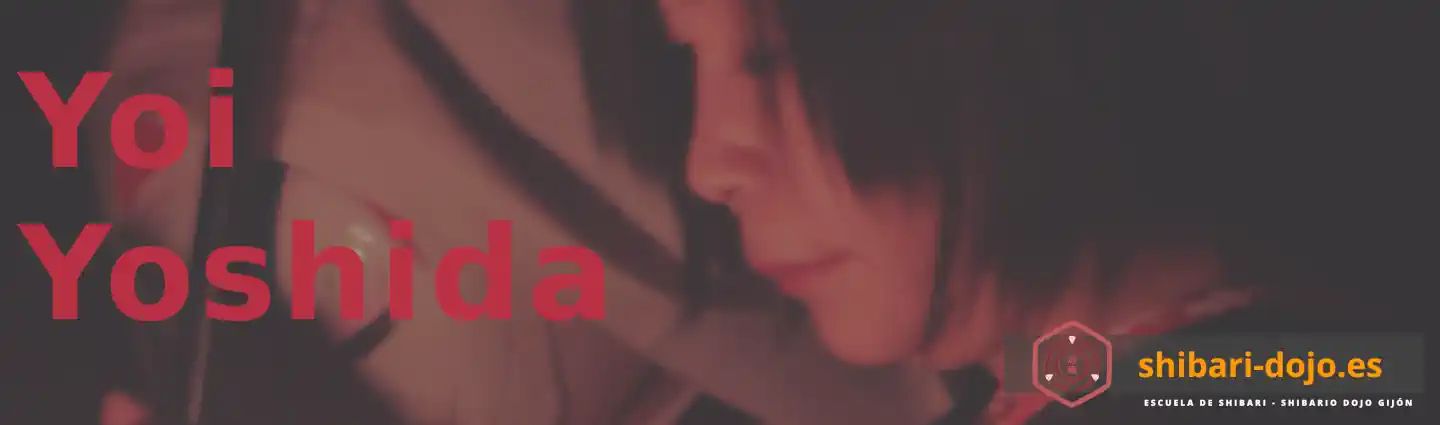
A legendary and beloved rope artist from Tokyo, she's best known for running the iconic spots UBU and mitsu alongside Bingo Shigonawa, but above all, for being the driving force behind Onawa Asobi—a festival celebrating "non-professional" shibari that's bridged continents and built bonds across the globe.
Yoi Yoshida's (吉田 洋) journey in shibari, much like her collaborator Bingo Shigonawa's, didn't follow the traditional path of formal training in a specific style or under a master. Instead, it grew from a mix of self-taught skills and hands-on learning through shared time and experiences with others.
What really stands out about Yoi's personality is her incredible social knack—she radiates energy that draws people in and builds communities wherever she goes.
Before diving into shibari, she built a career in market research and consulting. Ironically, those skills turned out to be key in managing and producing the events that define her legacy.
By the early 2000s, she was already helping organize casual meetups for shibari enthusiasts.
These gatherings were called "Onawa Asobi"—literally, "rope play."
Struggling to find steady venues led her, in 2007, to take a bold step: opening Good-Studio (Enma) in Tokyo's Kabukicho district, Shinjuku, making use of an empty space in her building.
This venue quickly became a beacon for a growing community—a hub where hobbyists rubbed shoulders with pros, photographers, and the simply curious.
It was in this vibrant mix that the seed for her signature project took root in June 2009: the very first Onawa Asobi event.
Her drive wasn't about making money; it came from the gut. Yoi noticed plenty of "bakushi" with top-notch skills who had no interest in going pro.
Onawa Asobi came to life to give them a stage, blending these hidden gems with established stars like Hajime Kinoko (一鬼のこ), Kasumi Hourai (蓬莱かすみ), or Bingo Shigonawa (紫護縄びんご).
The response was overwhelming, with nearly a hundred people showing up for the debut, proving just how eager folks were for fresh, genuine styles.
Note: In Japan, calling someone a "professional" in shibari means they work in the adult industry, often in porn or related clubs.
Aware of the unique angles women bring to kinbaku, Yoi Yoshida launched the "Onna Matsuri" (Women's Festival) in May 2010.
She saw that female artists, many coming from backgrounds as "dominatrices" in clubs, offered a form of dominance stripped of overt eroticism—rich with one-of-a-kind aesthetics and distinct emotions, like Kasumi Hourai's "wabi-sabi" approach.
The festival aimed not just to spotlight this special beauty, but also to offer a safe space for them to perform, free from the tiresome comparisons to their male counterparts.
Good-Studio's closure in 2012 wasn't the end—it sparked a transformation.
Teaming up with Bingo Shigonawa (紫護縄びんご)—a partner introduced by a mutual friend during the studio days—she opened Bar -UBU- and later its sibling spot, -mitsu-.
These quickly became go-to places for shibari fans, not just in Japan but worldwide. They welcomed travelers with open arms, eager to expand their horizons in shibari, and spread Good-Studio's ethos to an ever-growing international crowd.
Her take on shibari shows deep respect for variety. To her, there's no single "right" way to do it.
The key is harmony between the tier and the one being tied, as long as it's safe. Yet this open-minded view isn't naive.
Yoi Yoshida watches the flood of images on social media with concern, always pushing for responsible and safe sharing of knowledge—far from just copying poses without grasping the technique or underlying psychology.
She goes beyond being just an artist or producer; she's the heart of a global community she helped link up—a humble, graceful catalyst who's still pushing the boundaries of shibari.
Este contenido está reservado exclusivamente para suscriptores.
En nuestra página de suscripciones encontrarás varias opciones: la suscripción Kenkyo te da acceso completo durante 1 año a todos los artículos y recursos premium (no incluye los cursos), mientras que las otras suscripciones están pensadas para quienes también quieran acceder a los cursos y formaciones.
Ver todas las opciones de suscripción
This content is reserved exclusively for our subscribers.
We have different subscription plans to suit your needs: Kenkyo gives you 1 year of unlimited access to all premium articles and resources (courses not included), while our other plans are perfect if you also want to join the courses and training programs.