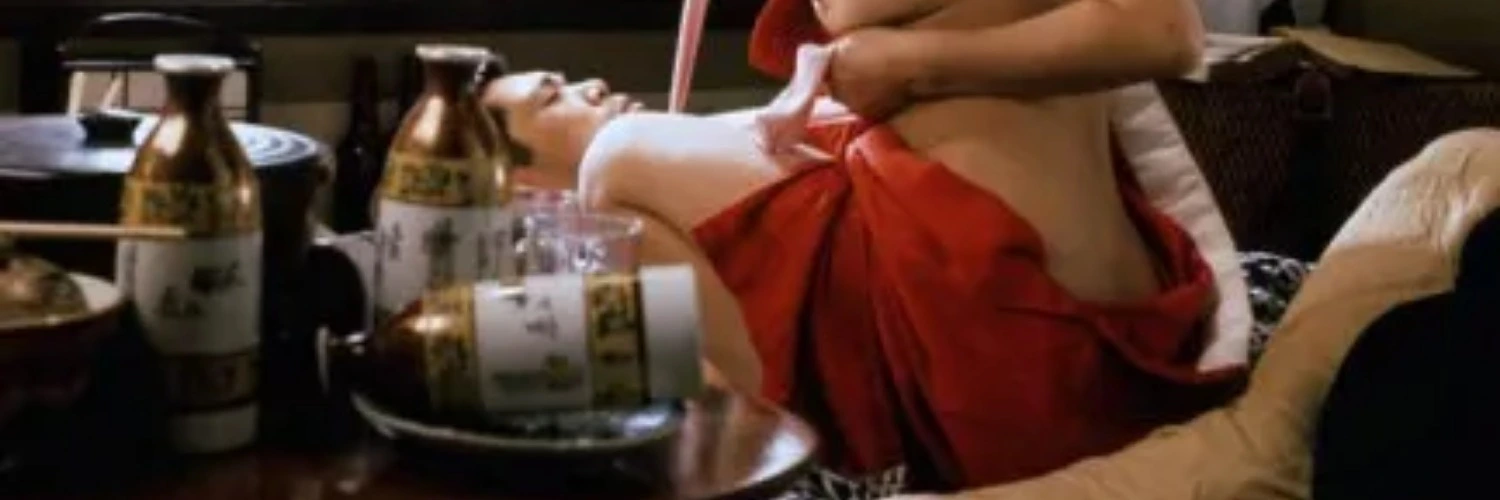
The gripping tale of Sada Abe has inspired multiple films, with the most famous in the West being In the Realm of the Senses (愛のコリーダ Ai no Korîda) by Nagisa Oshima.
The Story of Sada Abe
In 1936, a woman was found wandering the streets of Kyoto, clutching a knife, a rope, and a severed penis, her hands stained with blood.
That woman was Sada Abe, the lover of Kichi, a wealthy hotel owner where she’d once worked as a maid. Their obsessive relationship kept them holed up in a hotel room for weeks, consumed by each other.
This shocking true story forms the backbone of several films. In the West, Nagisa Oshima’s In the Realm of the Senses (愛のコリーダ Ai no Korîda) is the best-known, while in Japan, Noboru Tanaka’s A True Story of Sada Abe (実録・阿部定 Jitsuroku Abe Sada) gained widespread acclaim.
With military troops looming in the background of several scenes, the story is firmly set during Japan’s era of military expansion—a turbulent time worldwide.
In Japan, this period marked a clash between fading traditions and a creeping Western influence, driven more by the elite’s ambitions than by organic cultural shifts.
This historical context hits differently for Japanese audiences than for Westerners. As we’ve touched on before, locals are acutely aware of the brutality and weaponized sexual violence of the era, while Western viewers often romanticize these events.
Both films tell the same story but with distinct flavors. In the Realm of the Senses sidestepped Japan’s strict censorship laws by being produced and edited in France, making it more explicit. For many Europeans in the ‘70s and ‘80s, it was their first glimpse into what they saw as “Japanese perversions.”
A True Story of Sada Abe, on the other hand, digs deeper into the protagonist’s life and backstory. It’s more intimate, with a heavier erotic charge.
Sada Abe’s life was shaped by uncontrollable impulses and violence. Born to a wealthy merchant, she was raped as a teenager, then cast out by her family for the “dishonor” it brought.
For years, she survived as a prostitute, working in both legal brothels and shady underground dens, often clashing with clients and colleagues alike.
Eventually, she landed a job as a maid in a hotel, where she met Kichi (a cook in some accounts, a hotel owner in others). Their fiery relationship became the heart of In the Realm of the Senses.
The films depict unconventional practices—power dynamics, domination, and possession—laced with excess and indulgence. Both portray obsession and a lack of self-control with raw, unfiltered honesty, passing no judgment.
If you’re reading this, you’re probably curious about the kinky practices shown in these films.
As viewers, we can savor the highly erotic, now-iconic scenes that have seeped into pop culture. But we shouldn’t shy away from examining the motivations and reckless behaviors of the characters involved—not the practices themselves, but the lack of emotional control behind them.
For the sake of safe practices, it’s worth distinguishing between mutual desire and behaviors that have little to do with shared satisfaction.
Other films and even a series have tackled Sada Abe’s story, but they often lean into sensationalism or low-budget sleaze, lacking the depth or focus on the protagonists’ relationship found in these two standout works.
In the Realm of the Senses (愛のコリーダ Ai no Korîda)
Este contenido está reservado exclusivamente para suscriptores.
En nuestra página de suscripciones encontrarás varias opciones: la suscripción Kenkyo te da acceso completo durante 1 año a todos los artículos y recursos premium (no incluye los cursos), mientras que las otras suscripciones están pensadas para quienes también quieran acceder a los cursos y formaciones.
Ver todas las opciones de suscripción
This content is reserved exclusively for our subscribers.
We have different subscription plans to suit your needs: Kenkyo gives you 1 year of unlimited access to all premium articles and resources (courses not included), while our other plans are perfect if you also want to join the courses and training programs.