Every community develops a collective imaginary. Over time, images, symbols, figures, objects, or historical episodes appear that come to represent the group’s identity—even if, originally, they never truly belonged to it.
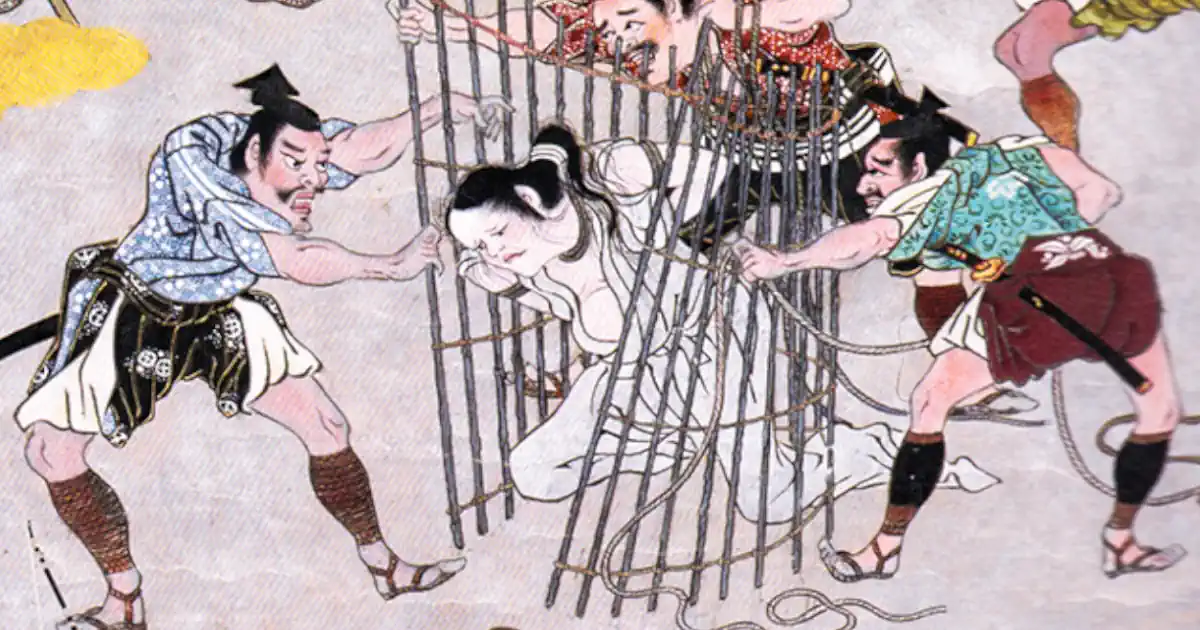
The image that illustrates this article belongs to volume 12 of the Jōruri Monogatari Emaki (浄瑠璃物語絵巻, Illustrated Scroll of the Tale of Jōruri), painted by the master Iwasa Matabei during the first half of the seventeenth century, in the Edo period. The work, designated an Important Cultural Property of Japan, is currently held at the MOA Museum of Art in Atami.
The scene depicts the climactic moment of the story. After discovering that the mother—or stepmother, depending on the version—of Lady Jōruri has indirectly caused the death of his beloved, the young warrior Minamoto no Yoshitsune (Ushiwakamaru) orders her execution. The woman is immobilized, wrapped in a bamboo mat (sumaki), and thrown into the river as punishment.
The image is harsh. It represents a violent public execution, an instructive manifestation of the power and justice characteristic of the medieval Japanese mindset.
And yet it is surprisingly common to find this and other similar images presented as supposed historical examples of “antecedents of shibari.”
At what point does a representation of an execution become an illustration of a contemporary erotic practice?
Answering that question requires setting shibari itself aside for a moment and observing a much broader phenomenon. Because, in reality, we are talking about the way communities construct their own narratives.
The Appropriation of the Past
Every community develops a collective imaginary. Over time, images, symbols, figures, objects, or historical episodes appear that come to represent the group’s identity—even if, originally, they never truly belonged to it.
This is a common process. Political movements reinterpret historical events; religions incorporate symbols from earlier cultures. Nations turn certain figures into national heroes centuries after their death.
Shibari is no exception. As with many relatively minority practices—at least from a statistical point of view—it too has developed a community with a high degree of personal involvement.
For many people it ceases to be merely an activity and becomes an important part of their identity.
And when a practice becomes part of the identity of those who practice it, the way the surrounding reality is interpreted also changes.
Images cease to be merely historical documents and become possible points of reference. Visual similarities are perceived as historical links.
And what was initially a simple iconographic coincidence can end up being incorporated into the collective narrative as if it had always formed part of it.
Most of these processes do not arise from a conscious will to falsify history. In fact, they tend to appear precisely where information is scarce, fragmentary, or difficult to verify.
The history of sexuality, of erotic practices, and of everyday life is extraordinarily difficult to reconstruct when we go back several centuries.
Even “modern” societies, with press, archives, and abundant written documentation, barely allow us to know with precision how the population really lived aspects as intimate as sexuality three or four hundred years ago.
In the Japanese case the difficulty is even greater. Linguistic barriers, the loss of documentation, cultural changes, and the historical tendency to separate the public sphere from the private mean that numerous aspects continue to be the subject of debate even among specialists.
That vacuum inevitably generates uncertainty, and where uncertainty exists, different possible narratives appear to explain the past.
Not all of those narratives have the same capacity to take hold. Communities tend to retain those that are more coherent with their own identity and that, in addition, help to reinforce it.
In other words, when definitive answers are lacking, the interpretations that provide historical continuity, prestige, or legitimacy usually have a greater chance of being accepted and disseminated than those that present the practice as a recent, isolated, or culturally marginal phenomenon.
It is precisely here that it becomes useful to introduce one of the most important concepts in this article: symbolic capital.
Symbolic Capital: When History Also Confers Prestige
The sociologist Pierre Bourdieu proposed that, in addition to economic capital or cultural capital, there exists a less tangible but extraordinarily influential form of social wealth: symbolic capital.
Symbolic capital is not measured in money or property. It manifests as prestige, recognition, legitimacy, or authority.
It is the value that a person, an institution, or a practice acquires when it is perceived as worthy of respect, relevant, or socially valuable.
A university founded five hundred years ago possesses a symbolic capital that does not depend solely on the quality of its teaching. A thousand-year-old temple, a protected designation of origin, or a centuries-old artisanal tradition also possess it.
Antiquity, historical continuity, and association with a cultural legacy generate a type of prestige that no advertising campaign can manufacture overnight.
Human communities have intuitively understood this mechanism for centuries.
That is why they seek genealogies, reclaim precursors, establish lineages, rescue historical figures, or reinterpret episodes from the past in order to incorporate them into their own narrative.
It is not only a matter of explaining where they come from. It is also a matter of explaining why they deserve to be recognized.
In this context, history ceases to be merely a discipline that studies the past and becomes a source of legitimacy for the present.
Shibari participates equally in this logic. Presenting it as an artistic practice that arose mainly during the twentieth century offers one particular historical narrative.
Presenting it as the culmination of a Japanese tradition several centuries old offers a very different one.
The two narratives do not only describe an origin; they also convey a valuation. The second suggests continuity, cultural depth, and authenticity. As a result, it accumulates considerably greater symbolic capital.
This does not imply that those who defend that interpretation are necessarily acting dishonestly. In many cases something far more subtle occurs.
When a community finds an image, a document, or a historical practice that visually recalls what constitutes its identity, it is natural to ask whether there is any relationship between the two.
That curiosity constitutes the starting point of any legitimate investigation. The problem appears when the direction of the reasoning changes and, instead of asking:
What does this image really represent within its historical context?
the question becomes:
How can this image be incorporated into the history of shibari?
The difference seems small, but methodologically it is enormous. In the first case, the historical context determines the interpretation. In the second, the contemporary interpretation begins to reorganize the historical context.
Research ceases to be based on sources and comes to be grounded in the identity of the group. This change usually begins through small, apparently innocuous incorporations:
an illustration that recalls a tie, a novelistic account, an old photograph, a print of a prisoner.
Each new example seems reasonable when considered in isolation. However, when dozens or hundreds of examples are progressively incorporated into the same narrative, the perception of the whole changes.
The community begins to experience an ever-greater sense of historical continuity. Not necessarily because conclusive new evidence has appeared, but because the narrative itself has gradually expanded what it considers part of its history.
This process is especially frequent when categories have diffuse borders. If no one can establish with clarity what falls inside and what falls outside a practice, virtually any significant resemblance can end up being interpreted as a legitimate antecedent.
And here a particularly interesting phenomenon appears: communities do not only select the past; they also select the questions they consider natural.
Over time it ceases to be surprising that an image of a medieval execution appears in a discussion about shibari; what begins to be surprising is that someone questions that association.
To understand how this change occurs, we must turn our attention to the way the human brain organizes and recognizes categories—in order to understand why certain images feel immediately familiar to us, why others are discarded almost without thinking and, above all, how a community can progressively expand the limits of a category to the point of modifying the very historical narrative it constructs about it.