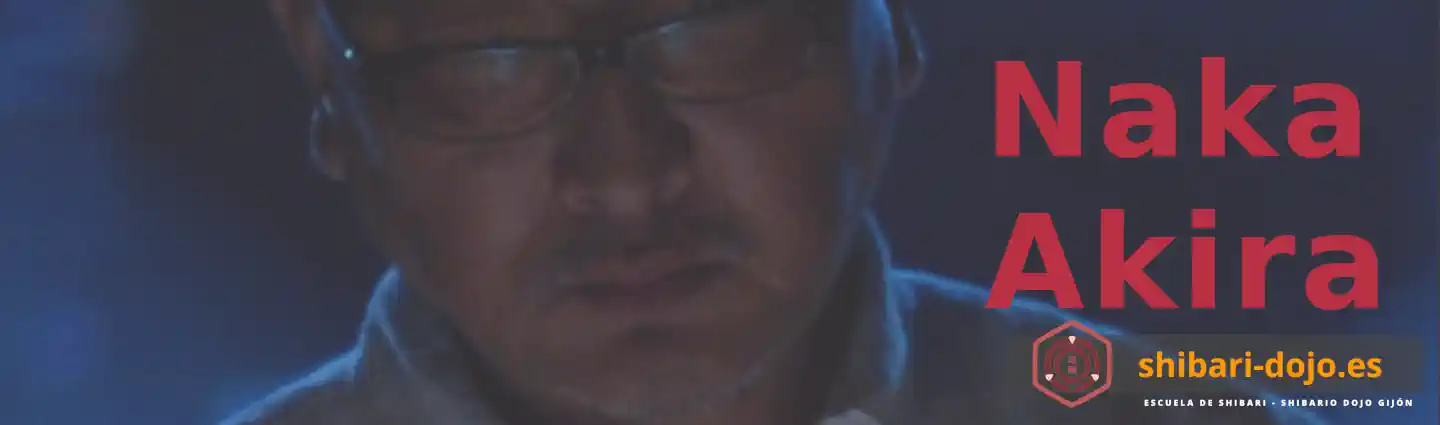
Naka Akira (奈加あきら) discovered the world of shibari relatively late—in his thirties—while managing a porn model agency.
He once accompanied an actress to a shoot by the production company Cinemagic, where he witnessed for the first time the work of the legendary Nureki Chimuo.
That moment changed everything. It revealed a deeply personal side he had long denied and marked the beginning of a lifelong devotion to kinbaku.
Invited by Nureki himself, Akira began attending the Kinbiken, the master’s private study group dedicated to bondage.
For five years he took part regularly, learning through the traditional Japanese approach of the apprentice who “steals” knowledge by observing in silence.
It took more than a year before Nureki even allowed him to untie a model—a symbolic gesture that, in that environment, meant formal recognition.
Eventually, Akira became the only disciple whom Nureki acknowledged as a direct deshi.
Decades later, a grave health complication nearly took his life. The experience pushed him to reassess his priorities, drawing him closer to his family and sharpening the precision and awareness behind his rope work.
Audiovisual Work
Naka Akira’s professional career began thanks to Yokobatake Kunihiko, president of Cinemagic, who invited him to handle the rope work for a video—on the condition that he also appear on camera.
With no acting experience, he reluctantly agreed, partly because his tattoos—crafted by master Horitoku and covering his back and shoulders with the legendary scene Oniwakamaru no Koi Taiji—gave him a striking visual presence.
The image depicts a monk battling a giant carp, a metaphor for courage and justice in Japanese folklore.
Since then, Akira has devoted himself almost entirely to video production, shooting between 200 and 300 films each year and, for many years, rarely appearing in magazines or live shows.
His series Nawa-etsu (Rope Joy) stands as one of the clearest reflections of his style: works focused solely on rope, free of additional SM elements, meticulously crafted for viewers who appreciate fine technical detail.
In 2015–2016, filmmaker Jikken Karasu created The Peony’s Whisper (牡丹の囁き), a fragmented documentary portrait blending Akira’s memories, childhood, aspirations, and stage presence—capturing the deeply human dimension behind the artist.
Stage and Performance
Although he did not perform publicly for many years, Akira eventually developed an interest in the stage as an emotional medium different from video.
From the start, he defined exactly what kind of presence he wanted to convey:
- avoiding aggressive or dominant aesthetics
- presenting the model with elegance
- working with a slow, meditative, emotional rhythm
- showing what the rope itself can express without props such as candles or whips
His style is marked by:
- extreme precision, clean lines, and finely controlled tension
- twists, arches, and compressions that reveal the body before the rope
- the exclusive use of traditional materials: seven‑meter asanawa, bamboo for suspensions, and a total absence of metal parts
- an emotional focus on expressing beauty through vulnerability and effort
Concepts such as ma (the pause, the distance), time management, bodily observation, and intention shape his entire approach.
Breath, sighs, and trembling become part of the shared experience.
Teaching
Naka Akira teaches following the Japanese tradition of learning through observation.
He corrects only what could be dangerous, allowing students to take initiative and “steal” knowledge for themselves.
His philosophy rests on the idea that “the rope is free”: beyond rigid forms, semenawa must adapt to each body, expression, and individual presence.
His students carry forward an approach where every rope, breath, and silence has meaning.
The Naka style emphasizes:
- subtle adjustments and refinements in semenawa
- reading the body and emotional response
- a demanding yet sensitive technique
- the use of time as both aesthetic and narrative tool
- the exploration of intention as the axis of each moment
Style and Influences
Although he is familiar with the work of other nawashi, Akira openly states that his only true influence is Nureki Chimuo.
He strives to master his teacher’s precision and reach his ability in kuzushi: those deliberate, subtle irregularities that make the rope seem alive—natural and profoundly expressive.
His declared goal is to become “the best nawashi in the world.”
Among his creative dreams, he has mentioned collaborating with violinist Kawaii Ikuko, whose playing, he says, reminds him of the emotional surrender of a woman in ropes.
Timeline
| Period | Highlights |
|---|---|
| 1970s–1980s | Born and raised in Japan; early fascination with tattoos. |
| Late 1990s–2000 | Runs a model agency; accompanies an actress to a Cinemagic shoot and discovers shibari through Nureki Chimuo. |
| 2000–2005 | Spends five years at the Kinbiken; becomes Nureki’s only formal deshi. |
| ~2005–2006 | Appears in his first Cinemagic video; launches professional career. |
| 2000s–2010s | Produces 200–300 films per year; develops the Nawa-etsu series. |
| 2014 | Suffers a major heart attack; redefines his priorities and deepens his style. |
| 2015–2016 | Premiere of The Peony’s Whisper. |
| 2010s–Present | Expands his stage work, workshops, and international teaching; consolidates a distinct style—rigorous, emotional, and refined. |