Content tagged as: #Bakushi (縛師)
A Generational Shift
The impact of lockdowns and the shutdown of public activity during COVID hit Japan’s professional shibari industry hard.
Several factors came together. On one hand, there were economic pressures caused by the lack of activity itself, made worse in Japan by the introduction of the new AV law, which almost brought shibari-themed adult video production to a standstill.
At the same time, the industry missed its technological moment. While the rest of the world quickly pivoted online, shibari—whether due to language, cultural, or legal barriers—failed to seize that opportunity.
Another key issue is the need for generational turnover among professionals.
Many of the well-known figures who rose to prominence during the Showa era are now at a stage in life where age and health are pushing them to step aside and make room for new talent.
That said, there was already a generation of “not-so-young newcomers”—performers with around twenty years of stage experience, most of whom are now in their forties.
We are talking about names like Yagami Ren, Hajime Kinoko, or Kasumi Hourai, who today act as the spearhead of Japanese shibari outside the archipelago.
And much like in a game of backgammon, when one piece leaves the board, another takes its place—and a new one fills the gap left behind.
A new wave of rope artists is beginning to stand out: first in events aimed at the domestic Japanese audience, and gradually—under the guidance of their mentors—making appearances abroad. For now, mostly at Asian adult festivals. But if the pattern holds, they will likely become regulars on the international workshop circuit within a couple of years.
Or maybe not.
During this period—known in Japan as the Reiwa era—shibari gained popularity outside Japan, moving from SM circles into mainstream media discourse. And in that shift, with the absence of prominent Japanese figures, Western practitioners have become the main reference point.
As surprising as it may sound, in our own school, most first-time students not only have no idea who Yagami Ren or Hajime Kinoko are—they simply do not care.
From a business standpoint, some event organizers are starting to hesitate when it comes to booking Japanese rope artists. The costs are high, and in most cases, they do not bring significantly more value than a skilled Western instructor—aside from a certain “exotic” appeal, which, when money is on the line, rarely holds up in the long run.
This globalization and shift in focus could deal a serious blow to the industry’s interests outside Japan.
Will they adapt to the times and deliver a product that is both high-quality and commercially viable? At the end of the day, this is an industry, and it runs on money.
Or will they stay true to their tradition—and their resistance to change—and remain a kind of outdated relic? A very Japanese response, though one they know how to package and sell under the aura of tradition and ancient mastery.
Time will tell. In the meantime, let’s take a look at some of the emerging figures in Japan’s professional shibari scene.
This article does not cover professionals focused on clubs or local services, but rather those with a more media-driven profile and an eye on the international market.
At the Tokyo Kinbaku Expo (summer 2024), a new generation of talent was introduced—artists poised to reshape the professional shibari landscape.
Among them is the already seasoned Tenma Haru (天馬ハル), mentoring younger performers such as Tenga Jin (天我迅), Yuki Scream (ゆきすくりーむ♂), and Sora (蒼空), who are often seen together in an event series known as “Kokonawa” (ココ縄).
Kokonawa (ココ縄)
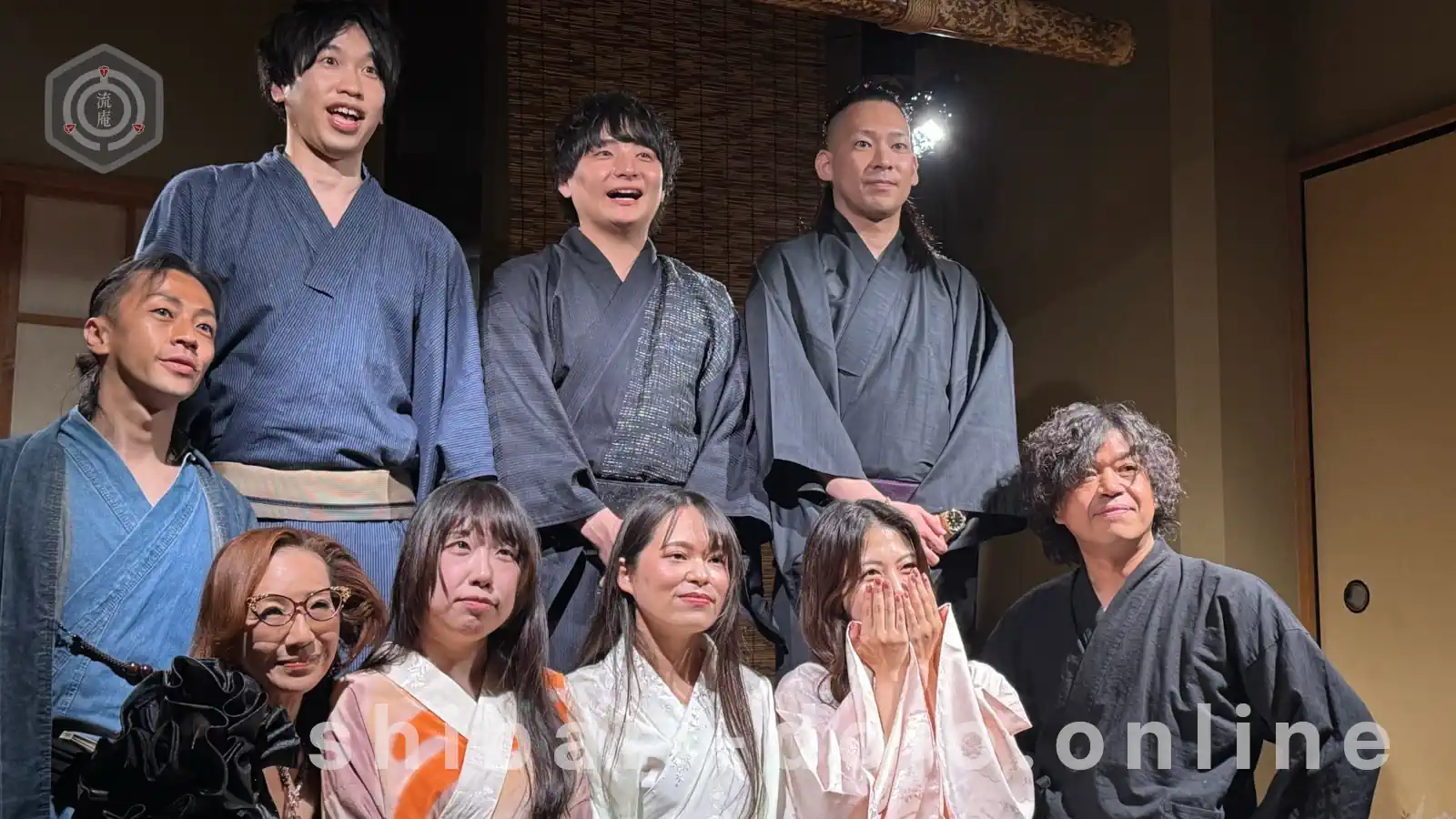
Kokonawa (ココ縄) “Kokonawa” refers to a series of recurring events, occasionally held with a live audience but primarily streamed online via paid access available worldwide.
The series is produced and hosted by Marie Aoi (三代目 葵マリー), featuring Yagami Ren and Tenma Haru as expert voices and mentors supporting the young rope artists.
The first edition was a hybrid event—live and streamed—featuring technical support from the production company DOGMA and performances by Yagami Ren, Tenma Haru, Yuki, and Sora.
It consisted of live demonstrations interspersed with interviews. The event sold out, and notably, drew a large number of young attendees, including many women.
A second edition followed in 2024, this time fully online via the FC2 streaming platform, featuring Sora, Yuki, and BEST (now Tenga Jin), each presenting a 40-minute show.
Since then, multiple editions have been held each year, turning Kokonawa into a key platform where this group showcases its style and evolution.
Tenga Jin (天我迅)
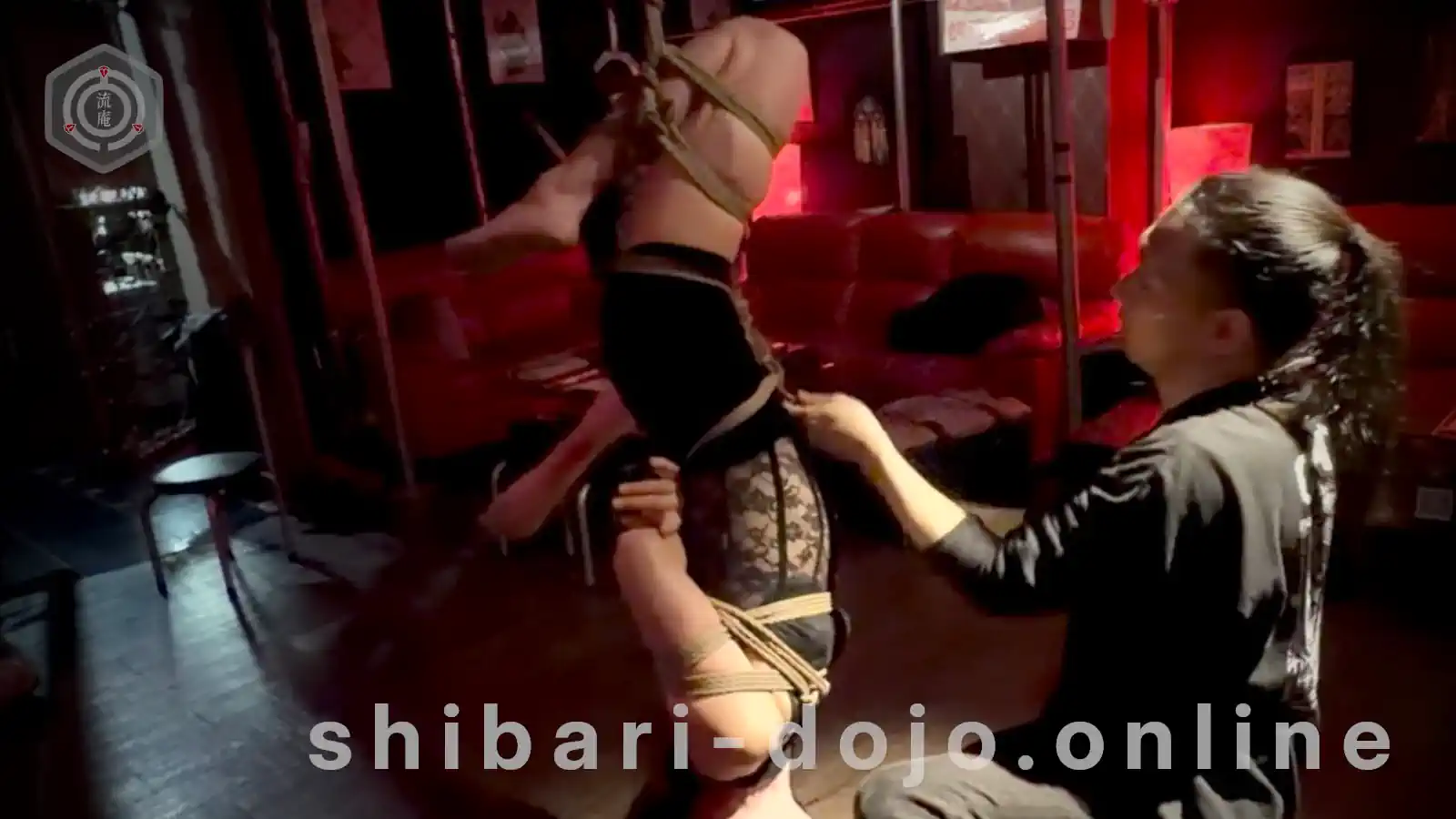
Tenga Jin (天我迅) Previously known as BEST, he adopted the stage name Tenga Jin (天我迅) in 2025.
“Tenga” comes from the phrase “Tenjo Tenge Yui Ga Dokuson” (“Above heaven and earth, I alone am honored”). “Jin” is drawn from “Shippū Jinrai no Jin” (the speed and force of a storm). He chose it because it sounds fast and striking.
He practices Tenga-ryu (天我流), a style inspired by Yagami-ryu (鵺神流).
He trained within the circle of Yagami Ren and Tenma Haru, particularly under the guidance of Manabu (まなぶ), a former Yagami-ryu instructor in Tokyo.
He debuted as a professional performer in 2023 and took part in around 40 events in 2024. He mainly performs in Tokyo, but also in Nagoya and the Kansai region. He is a regular on the Tokyo and Osaka scenes, frequently appearing in SM clubs and bars.
In his own words, his shows are “built around the theme of ‘distorted love’ (歪な愛), grounded in traditional Japanese aesthetics (‘wa’, 和). The goal is for kinbaku to stand as entertainment in its own right—not just be inserted into entertainment.”
He is supported by Nagare Aotsuki (蒼月), manager of the Arcadia club group, and by historical Kabukicho figures such as the late Bingo Shigonawa (紫護縄びんご) of UBU.
Sora (蒼空)
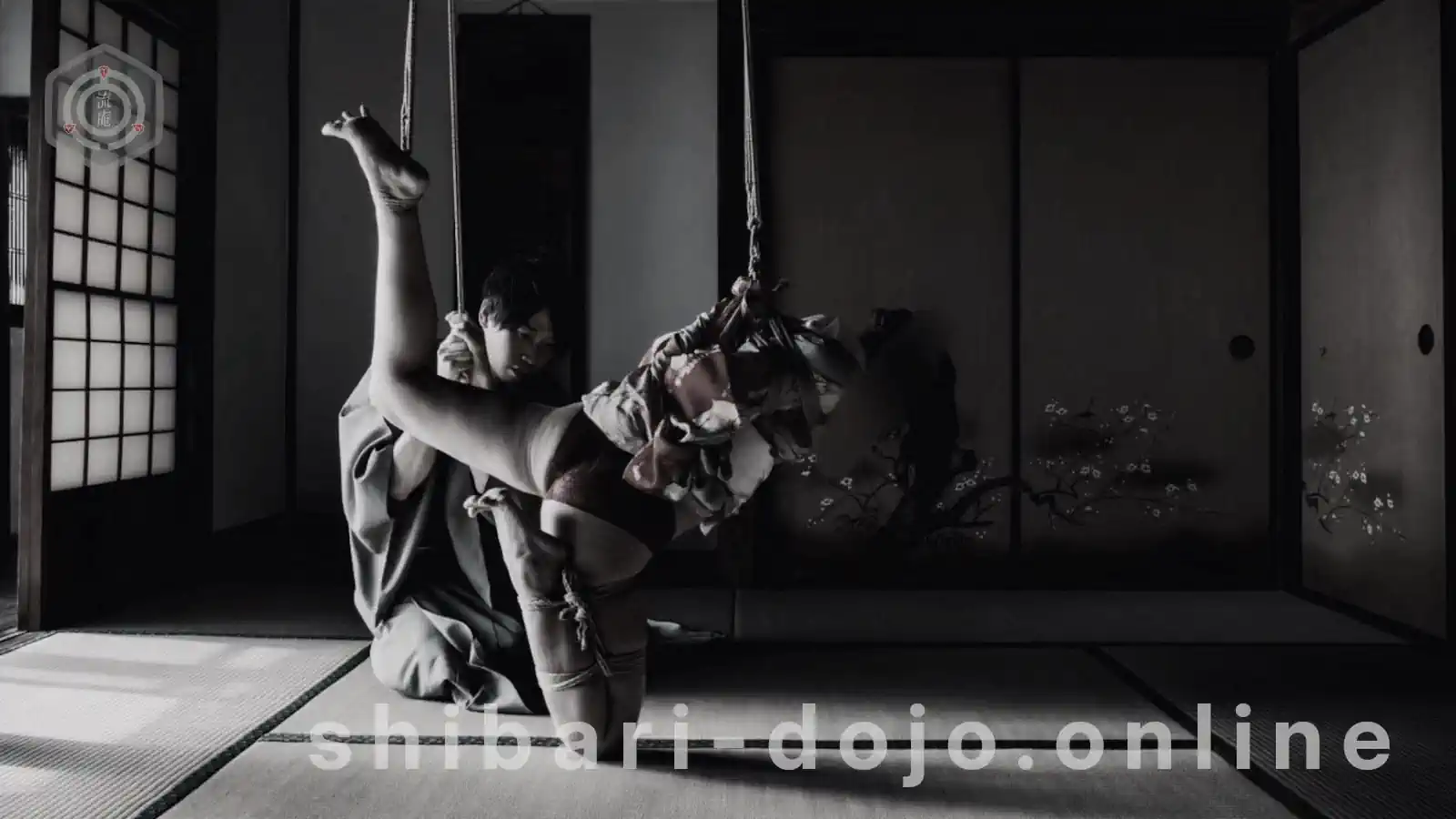
Yuki Scream (ゆきすくりーむ) A direct disciple of Tenma Haru, Sora practices Tenma-ryu and works as an instructor at the Genso Nawa Kai salon in Yokohama.
He specializes in combining semenawa with no-iki (brain orgasm).
According to him, he was drawn to the Tenma style because every rope has a clear purpose and meaning.
His main profession is as a host in the women-focused erotic service industry (女風俗), where he has worked successfully for over seven years as a male “therapist” at the establishment Kindan no Kajitsu -RINGO- (“Forbidden Fruit”), where he is often a top-billed performer.
He debuted as a performer in 2019 at “Onawa DX” in Kabukicho and joined the Kokonawa staff in 2024. That same year, he was introduced at the Tokyo Kinbaku Expo as one of the scene’s rising talents.
He frequently participates as a co-instructor in Tenma Haru’s workshops across Asia.
Yuki Scream (ゆきすくりーむ♂)
He entered the world of shibari in June 2020. Before that, he was involved in off-pakora (private encounters). He is a regular rope artist at the TittyTwister club in Tokyo.
He is also part of the Kokonawa team.
Miss Lina (緊縛師)
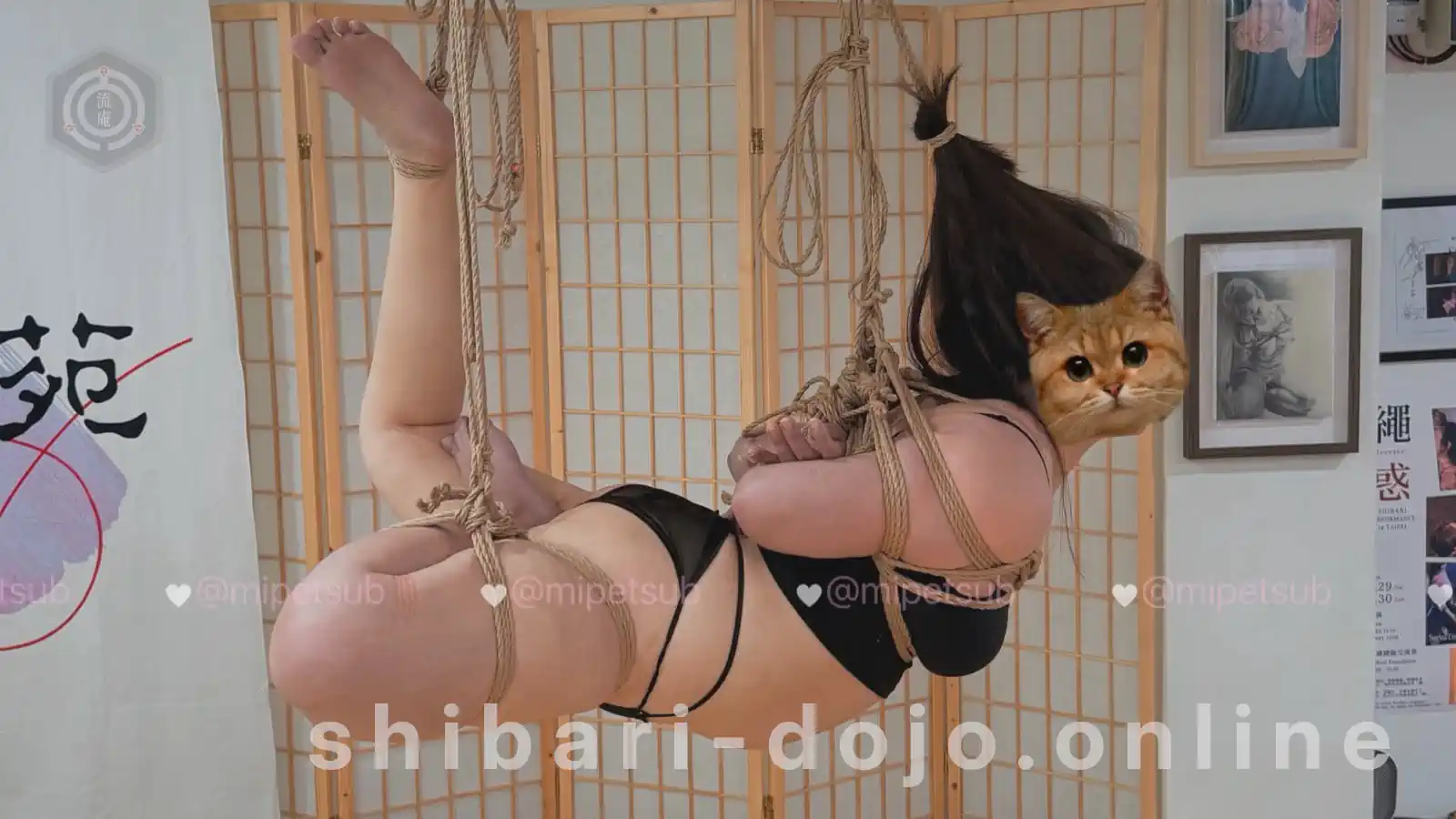
Miss Lina (緊縛師) A Taiwanese rope artist and apprentice of Tenma Haru and Sora.
She works as a Chinese interpreter and organizes Tenma-ryu workshops in Taiwan, where she also coordinates regular shibari events.
In her own words, she follows the spirit of Tenma-ryu in her kinbaku journey: “Think about the tie, think about the one who ties, think about the people.”
The Weight of Tradition
In Japan, as elsewhere, there is a common mindset: if something works, do not change it.
This entire group operates as apprentices to senior rope artists, adopting and internalizing their respective styles. The industry is largely controlled by conservative figures who prefer to preserve what has worked since the 1980s—an approach that has generated significant income through international tours.
This traditional conservatism also extends to the training system, which is based on repetition: copying the master’s ties over and over until achieving a perfect replica.
It is a very Japanese way of thinking and working, but it does not translate well to a contemporary Western context that values differentiation and personalization.
In disciplines like shibari, this teaching model does little to help the technique evolve or address longstanding issues, such as the risks of abuse or injury.
It was precisely this rigidity in Japanese teaching methods that led us, at the beginning of the Reiwa era, to develop our own shibari teaching method: #MSAFE.
No-iki (脳イキ): “Brain Orgasm”
The term no-iki can be translated as “brain orgasm” and falls within the realm of ASMR (Autonomous Sensory Meridian Response).
It is a somewhat elusive phenomenon, to put it mildly, and like hypnosis, it depends on the subject’s susceptibility to suggestion.
Its effects are described as a sense of relaxation or mental haze, often induced through whispers, soft sounds, and slow, repetitive movements.
Used responsibly, it is just another technique—no more harmful than listening to white noise to fall asleep or relax.
However, in contexts like shibari—where behavior, perception of reality, and judgment can already be influenced by both the rigger and the setting—it can pose a risk. The combined sensory and emotional effects, along with the expectations placed on the person being tied, can make them more vulnerable to coercion or to adopting behaviors not driven by their own desire, but by the context.
It is important to note that these rope artists operate within professional service environments, working with clients—a reality quite different from what most Western shibari practitioners are used to.
Sora himself described his approach to sessions as follows:
“Only when they are tied with rope do they no longer need to think about anything. They can hand everything over to the person tying them and simply feel the rope. It is okay to fall apart. Precisely because they are bound and immobilized, the heart can become free. That is one of the appeals of rope. For people who are always tense and trying hard to get through life, it is a moment to release that effort and return to their true self.”
In many cases, clients seek these services as a way to escape—an opportunity to disconnect from stress and everyday concerns.
At Shibari Dojo, we are not opposed to professional services related to sex. However, we do emphasize the wide range of risks that can arise from their misuse or from unhealthy patterns of engagement.
Aoi Marie (葵マリー)
Aoi Marie (葵マリー) is one of the most legendary names in Japanese SM. Since the 1980s, this title has been passed down as a sort of inherited mantle—becoming a genuine “brand” in Japan’s adult entertainment scene.
Let’s take a closer look at this generational system and the figures behind each 葵まりい (Aoi Marii).
Este contenido está reservado exclusivamente para suscriptores.
En nuestra página de suscripciones encontrarás varias opciones: la suscripción Kenkyo te da acceso completo durante 1 año a todos los artículos y recursos premium (no incluye los cursos), mientras que las otras suscripciones están pensadas para quienes también quieran acceder a los cursos y formaciones.
Ver todas las opciones de suscripción
This content is reserved exclusively for our subscribers.
We have different subscription plans to suit your needs: Kenkyo gives you 1 year of unlimited access to all premium articles and resources (courses not included), while our other plans are perfect if you also want to join the courses and training programs.
Kamijoo Saki (上条早樹)
Kamijoo Saki (上条早樹) — mistress, rope artist, musician, and event producer — moves between the intersecting worlds of SM, shibari, and punk rock with the confidence of someone who’s built her universe from the ground up.
Born in Japan’s Kansai region during the 1970s (in the Shōwa era), she has stayed deeply connected to her roots ever since, especially in Kobe, a city whose grit and rhythm fit perfectly with her sensibility.
She stepped into the professional SM scene around 2004 through Kansai’s underground community, opening her first venue, SM PISS, in Osaka.
The club quickly became a cornerstone of local SM culture and her creative home base — a space where she could experiment freely, merging kinbaku and live performance in ways few had done before.
It was there that she laid the foundation for her dual identity as both mistress and kinbakushi.
In her early years, Kamijoo made her mark on major domestic stages such as DX Kabukichō (DX歌舞伎町) and Theater POO (シアターPOO). By 2012, her art had crossed borders.
She began touring abroad — Taiwan, the United States, Mexico, and Europe — carrying the raw and theatrical energy of Japan’s underground SM culture into international spaces.
As her career expanded, music became inseparable from her identity. A vocalist and guitarist, Kamijoo channels unfiltered rock energy through an SM horror lens in shows like the Rokkin Shibari Horror Show (ロッきん縛ホラーショー) — a wild, provocative fusion that is unmistakably hers.
In the early days, she was known as “the fastest kinbakushi in the world.” Over time, her technique evolved beyond speed into something more cinematic — storytelling through rope, performance, and atmosphere.
Her current stage work blends eroticism, theater, and collaboration while keeping the bold edge that has always defined her.
Based mainly in Osaka and Kobe, Kamijoo lives what she performs.
Her love of music and nightlife is legendary, as are her fondness for beer, shōchū, fish roe, and Marlboro cigarettes.
The smoky, electric energy of rock and the haunting allure of erotic horror don’t just influence her—they shape the world she builds on stage.
Largely self-taught in kinbaku and SM performance, she developed a fast, visceral style that combines speed, tension, and theatrical impact.
Her fascination with punk, rock, and horror binds her performances together into something visceral and unmistakably personal.
A familiar figure in both Osaka and Tokyo’s SM circles, she has performed and collaborated with leading artists such as Akira Naka (奈加あきら), Nawashi Kanna (縄師カンナ), and Norio Sugiura (杉浦則夫).
As a mentor, she has trained performers including Kamijō Hayaju (上条早樹) and Hoshiya Aya (星谷亜耶), emphasizing speed, safety, and expressive artistry in bondage.
Major Career Milestones
Este contenido está reservado exclusivamente para suscriptores.
En nuestra página de suscripciones encontrarás varias opciones: la suscripción Kenkyo te da acceso completo durante 1 año a todos los artículos y recursos premium (no incluye los cursos), mientras que las otras suscripciones están pensadas para quienes también quieran acceder a los cursos y formaciones.
Ver todas las opciones de suscripción
This content is reserved exclusively for our subscribers.
We have different subscription plans to suit your needs: Kenkyo gives you 1 year of unlimited access to all premium articles and resources (courses not included), while our other plans are perfect if you also want to join the courses and training programs.
Kamui Jubei (神威十兵衛)
Nacido el 13 de septiembre de 1959, Kamui Jūbei es una de las figuras más respetadas del kinbaku clasico. Él mismo se define como 「傀儡の緊縛師」 (kugutsu no kinbakushi), «el titiritero de la cuerda»,.
Kazami Ranki (風見蘭喜)
A native of Osaka and a regular event organizer in Tokyo, Kazami Ranki is a name that needs no introduction in Japanese shibari circles.
As the founder of Kazami-ryū (風見流), his school saw a significant period of international growth roughly a decade ago, with performances and workshops across North America, Europe, and Oceania.
Ken’ichi Murata (村田兼一)
Ken’ichi Murata (村田兼一, Murata Ken’ichi), born in 1957 in Osaka, Japan, stands out as one of the most unique and provocative contemporary photographers in the Japanese erotic art scene.
Naka Akira (奈加あきら)
Naka Akira (奈加あきら) discovered the world of shibari relatively late—in his thirties—while managing a porn model agency.
He once accompanied an actress to a shoot by the production company Cinemagic, where he witnessed for the first time the work of the legendary Nureki Chimuo.
That moment changed everything. It revealed a deeply personal side he had long denied and marked the beginning of a lifelong devotion to kinbaku.
Invited by Nureki himself, Akira began attending the Kinbiken, the master’s private study group dedicated to bondage.
For five years he took part regularly, learning through the traditional Japanese approach of the apprentice who “steals” knowledge by observing in silence.
It took more than a year before Nureki even allowed him to untie a model—a symbolic gesture that, in that environment, meant formal recognition.
Eventually, Akira became the only disciple whom Nureki acknowledged as a direct deshi.
Decades later, a grave health complication nearly took his life. The experience pushed him to reassess his priorities, drawing him closer to his family and sharpening the precision and awareness behind his rope work.
Audiovisual Work
Naka Akira’s professional career began thanks to Yokobatake Kunihiko, president of Cinemagic, who invited him to handle the rope work for a video—on the condition that he also appear on camera.
With no acting experience, he reluctantly agreed, partly because his tattoos—crafted by master Horitoku and covering his back and shoulders with the legendary scene Oniwakamaru no Koi Taiji—gave him a striking visual presence.
The image depicts a monk battling a giant carp, a metaphor for courage and justice in Japanese folklore.
Since then, Akira has devoted himself almost entirely to video production, shooting between 200 and 300 films each year and, for many years, rarely appearing in magazines or live shows.
His series Nawa-etsu (Rope Joy) stands as one of the clearest reflections of his style: works focused solely on rope, free of additional SM elements, meticulously crafted for viewers who appreciate fine technical detail.
In 2015–2016, filmmaker Jikken Karasu created The Peony’s Whisper (牡丹の囁き), a fragmented documentary portrait blending Akira’s memories, childhood, aspirations, and stage presence—capturing the deeply human dimension behind the artist.
Stage and Performance
Although he did not perform publicly for many years, Akira eventually developed an interest in the stage as an emotional medium different from video.
From the start, he defined exactly what kind of presence he wanted to convey:
- avoiding aggressive or dominant aesthetics
- presenting the model with elegance
- working with a slow, meditative, emotional rhythm
- showing what the rope itself can express without props such as candles or whips
His style is marked by:
- extreme precision, clean lines, and finely controlled tension
- twists, arches, and compressions that reveal the body before the rope
- the exclusive use of traditional materials: seven‑meter asanawa, bamboo for suspensions, and a total absence of metal parts
- an emotional focus on expressing beauty through vulnerability and effort
Concepts such as ma (the pause, the distance), time management, bodily observation, and intention shape his entire approach.
Breath, sighs, and trembling become part of the shared experience.Teaching
Naka Akira teaches following the Japanese tradition of learning through observation.
He corrects only what could be dangerous, allowing students to take initiative and “steal” knowledge for themselves.
His philosophy rests on the idea that “the rope is free”: beyond rigid forms, semenawa must adapt to each body, expression, and individual presence.
His students carry forward an approach where every rope, breath, and silence has meaning.
The Naka style emphasizes:
- subtle adjustments and refinements in semenawa
- reading the body and emotional response
- a demanding yet sensitive technique
- the use of time as both aesthetic and narrative tool
- the exploration of intention as the axis of each moment
Style and Influences
Although he is familiar with the work of other nawashi, Akira openly states that his only true influence is Nureki Chimuo.
He strives to master his teacher’s precision and reach his ability in kuzushi: those deliberate, subtle irregularities that make the rope seem alive—natural and profoundly expressive.
His declared goal is to become “the best nawashi in the world.”
Among his creative dreams, he has mentioned collaborating with violinist Kawaii Ikuko, whose playing, he says, reminds him of the emotional surrender of a woman in ropes.
Timeline
Period Highlights 1970s–1980s Born and raised in Japan; early fascination with tattoos. Late 1990s–2000 Runs a model agency; accompanies an actress to a Cinemagic shoot and discovers shibari through Nureki Chimuo. 2000–2005 Spends five years at the Kinbiken; becomes Nureki’s only formal deshi. ~2005–2006 Appears in his first Cinemagic video; launches professional career. 2000s–2010s Produces 200–300 films per year; develops the Nawa-etsu series. 2014 Suffers a major heart attack; redefines his priorities and deepens his style. 2015–2016 Premiere of The Peony’s Whisper. 2010s–Present Expands his stage work, workshops, and international teaching; consolidates a distinct style—rigorous, emotional, and refined. Nawa houshi
縄奉仕
Shibari History (2/3): Evolution
History of shibari without myths. Part 2: Development and spread
Shibari History (3/3): Nowadays
History of shibari without myths. Part 3: Analysis of shibari in our days.
Tenma Haru (天馬ハル)
Jovial atador japonés, nacido el 20 de mayo de 1975 en la prefectura de Kanagawa. Ha sabido mezclar conceptos clásicos y modernos en un estilo propio, el Tenma-ryu (天馬流), que separa explícitamente el kinbaku del sadomasoquismo y lo orienta hacia la conexión emocional entre dos personas.
Tenma Haru (天馬ハル)
A jovial Japanese rigger, born May 20, 1975, in Kanagawa Prefecture. He has managed to blend classic and modern concepts into a style all his own, the Tenma-ryu (天馬流), which explicitly separates kinbaku from sadomasochism and steers it toward the emotional connection between two people.
The Yukimura Approach to Shibari (雪村流)
The shibari style developed by Yukimura Haruki (雪村春樹) represents an approach to kinbaku in which the rope transcends its function as a mere tool and becomes a medium of silent communication.
Tohjiro (伊藤智生)
Some life paths, when seen from the outside, seem contradictory. Tohjiro’s is one of them — the stage name of Ito Tomoo (伊藤智生), also credited in some early works as Ito Yuichi (伊藤裕一).
Yoi Yoshida (吉田 洋)
A legendary and beloved rope artist from Tokyo, she's best known for running the iconic spots UBU and mitsu alongside Bingo Shigonawa, but above all, for being the driving force behind Onawa Asobi—a festival celebrating "non-professional" shibari that's bridged continents and built bonds across the globe.
Yukimura Haruki (雪村春树)
Haruki Yukimura (雪村春树, 1948–2016) was, without question, one of the most influential, prolific, and singular Japanese rope artists of his time.
A photographer, reggae musician, performer, audiovisual producer, and kinbaku master, he spent more than three decades honing his craft—fundamentally transforming how Japanese shibari was perceived, both domestically and abroad.
His intimate, emotional, and deeply human approach made him a touchstone within the field, and his legacy continues to live on through his students and an extensive visual archive.
Born on May 11, 1948, in Hyōgo Prefecture, Japan, Yukimura was raised in the Kansai region. This upbringing left him with a distinct Osaka accent—something many recall as inseparable from his personality: direct, ironic, and warmly approachable.
The Osaka dialect (Osaka-ben) is often described as blunt, expressive, and lively, closely tied to humor and the open, outgoing nature of the region’s people. Compared to standard Tokyo Japanese, it sounds more melodic yet rougher in tone, and it remains a hallmark of Japanese comedy, commonly associated with lighthearted or informal characters.
From an early age, Yukimura showed a deep interest in the audiovisual arts, along with a fascination for bondage and its place within the Japanese imagination—particularly as depicted in historical period dramas scenes of restraint.
Before fully devoting himself to kinbaku, Yukimura began his career as a professional photographer, spending several years working across various fields.
During this period, he developed a strong technical foundation and a refined eye for composition, framing, and the emotional expression of the human form.
In his thirties, he turned his focus to erotic photography, a field that allowed him to explore themes of intimacy, vulnerability, and desire more freely.
In 1982, he began collaborating as a photographer with S&M Sniper, one of Japan’s most influential SM magazines at the time.
At first, rope work was merely one aspect of his visual repertoire. Gradually, however, it took center stage. What began as a visual device evolved into the core of his artistic expression.
By the mid-1980s, with the emergence of new video formats, Yukimura expanded his work into the audiovisual medium.
In 1986, he permanently adopted the artistic name Haruki Yukimura (雪村春樹), under which he would gain international recognition.
The following year, he founded his own production company, Sunset Color (サンセットカラー), giving him complete creative independence.
From 1992 onward, his output was astonishing: he produced up to twenty videos a year, ultimately amassing several thousand works across video, photography, and print.
Throughout the 1990s, Yukimura also began performing live shows, notably at the Shinjuku Golden Gai Theater (新宿ゴールデン街) in Tokyo.
These performances, known as Y’s Play Bondage, were recorded and later distributed, helping to cement his reputation and spread his influence worldwide.
Over time, Yukimura refined a language uniquely his own—centered on emotion, shame, and the silent dialogue between rope, rigger, and bound body.
This approach ultimately crystallized into what is now known as Yukimura-ryū (雪村流), a lineage distinguished by its focus on tenderness and psychological depth.
His studio in Shibuya, Tokyo, became a vital reference point for both Japanese and international practitioners. Over the years, countless riggers came to his dojo in search of guidance, though Yukimura granted bakushi names and teaching licenses to only a select few.
Among his most significant collaborations was his partnership with Sugiura Norio (杉浦則夫), with whom he created landmark works in the history of kinbaku.
He was also frequently documented and interviewed by Osada Steve (春嶺, Harumine), one of his most internationally recognized students.
For much of his career, Yukimura taught almost exclusively within Japan. In his later years, however, he began sharing his knowledge with a small circle of Western practitioners.
In 2012, he led his first workshop outside Japan, at the Copenhagen Shibari Dojo—a milestone in the international transmission of his work.
Though he never actively sought global fame, his influence continued to spread, and today his name holds an essential place in the international rope scene.
In 2010, Yukimura was diagnosed with lung cancer, an illness he continued to fight while working and teaching for as long as his health allowed.
Haruki Yukimura passed away on March 3, 2016, in a Tokyo hospital, at the age of 67.
His legacy remains vast and profound—a monumental body of audiovisual work, countless photographic series and publications, and a generation of students who continue to embody his vision and sensitivity.
Beyond technique or style, Yukimura is remembered for placing emotion, shame, and intimacy at the heart of kinbaku—infusing it with humanity and opening what was once a marginal subgenre to a much broader emotional landscape.
Yukimura— Punk at Heart
Beyond his fame as a kinbaku master, Haruki Yukimura (雪村春樹) deserves recognition as a visionary creator with a deeply personal—and, at the time, radical—approach.