壱本縛り Ippon Shibari is the third formal application of the Yagami Ryu style.
Warning: This technique is dangerous. Practice with caution, and if in doubt, consult your instructors. Do not take unnecessary risks.
This form combines body, rope, and control techniques, allowing not only for restraint but also for stimulus and refined body management. It develops both constraint and flow in movement.
According to Yagami Ren:
Focusing on the rope and copying the pattern is not the point.
In this style of shibari, the key lies in understanding the body’s and mind’s mechanisms; the rope comes later, and once you understand that, you’ll know intuitively what to do with it.
If all you see is the visible pattern, you’re missing the essence.
This form isn’t a simple variation of the strappado—its purpose is to enable control and management of the tied body.
Once you understand how it acts on the body, you’ll grasp why it’s called “one of ten.”
Meaning of the name
The Japanese language loves double meanings and layered interpretations—and this is one of those cases.
Ippon serves as a counter used for long, cylindrical objects such as sticks or ropes.
Thus, ippon shibari literally refers to ties made with a single rope.
It shouldn’t be confused with ichinawa shibari, the name of Japanese rigger Hajime Kinoko’s school (his nickname “Ichi” refers to being the firstborn in his family).
However, in this case, Yagami Ren uses the expression in the same sense as in martial arts, meaning a technique of exceptional efficiency.
In Japanese, it can imply “one of ten,” an idea that might be better captured in Spanish—or English—through a chess analogy: “checkmate in one.”
Warnings
Because of that efficiency, this is a highly dangerous technique that carries a serious risk of injury if performed without proper knowledge and precautions.
Before attempting it, always consult your instructors for personalized guidance and safe adaptation.
Do not mistake this form for a strappado or shakuhachi; while visually similar, their techniques and purposes are entirely different.
Aesthetic
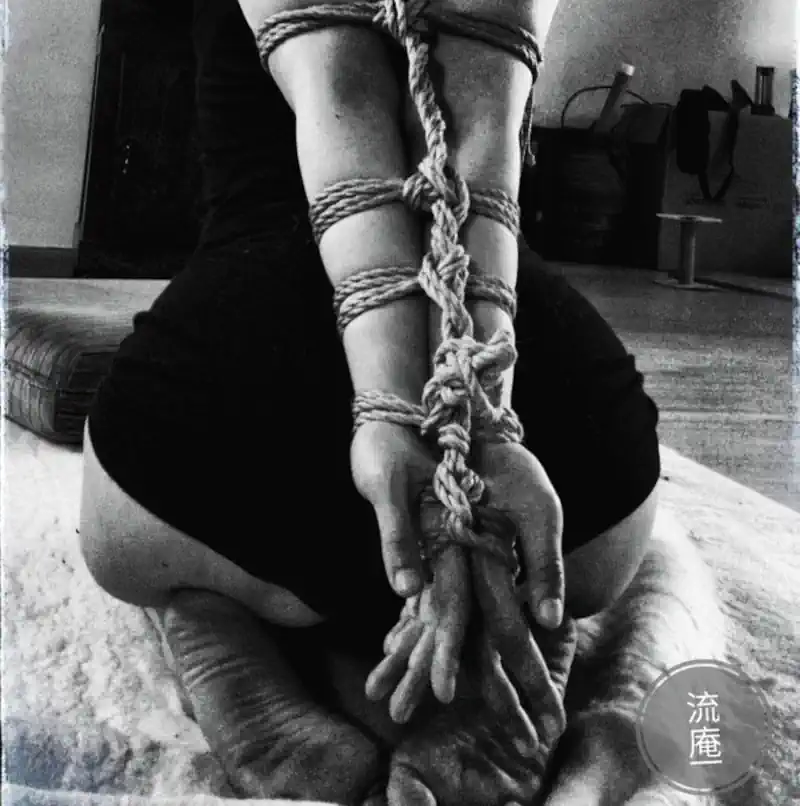
This is one of the most recognizable and most frequently imitated forms of Yagami Ryu, though often poorly reproduced.
Its strength as a restraint—locking the arm joints (shoulder, elbow, and wrist)—and the intense physical demand it places on the tied person create both a striking visual and a powerful experience.
“As with everything in the Yagami style—if you focus only on what your eyes can see, you’re not seeing what’s actually happening.”
Functionality
When applied correctly, this form achieves one of the most anatomically efficient restraints, since the complete immobilization of the tied person can be achieved with only two fingers—and without applying any force.
In the first movement, the rigger should accomplish total arm restriction without using strength.
Combined with the intelligent use of fu-chin, this form becomes one of the most intense, demonstrating the depth and potency of sekibaku in managing erotic desire.
It’s important to stress that the rope itself plays only a secondary role in this form.
It’s enough to apply it efficiently in one key point; everything else is merely reinforcement and ornamentation.
In other words, don’t get caught up in the decorative shapes—those are superficial.
A poorly executed version of this technique will, at best, be inefficient and a waste of time and energy—but it can also pose a serious risk of injury.
It borrows techniques originally designed to injure or disable; without control and understanding, that risk multiplies.
Improper execution may cause severe injuries, particularly to soft tissues.
Remember: ignorance is no excuse.
Each practitioner is individually responsible for their own knowledge, its use, and their lack thereof.
Using techniques you don’t understand is irresponsible and puts your partner at risk.
Sekibaku is founded on personal responsibility, and without knowledge, there can be no responsibility.
If you want to learn more about this form and you’re near Asturias, visit the Shibari Salon during the scheduled sessions.
The tie’s effect isn’t simply to “open the chest” or expose the sides—it also shifts the body’s center of gravity, allowing for smoother, more efficient control and management of the body.
That’s the essence of this tie: with just one rope and a few precise movements, to create restraint, control, and vulnerability.
But take care—this is a dangerous technique.
Attempting to reproduce it from photos is risky. Using it without understanding what you’re doing is reckless, and the chance of injury is high.
Prerequisites
As usual, certain foundational skills apply to all forms—but in this case, Ippon especially helps refine the following techniques:
- Posture and balance (Shisei 姿勢)
- Grip (Kote tori 小手取)
- Tension in body and rope (Chōryoku 張力)
- Body handling (Tenbindori 天坪鳥)
- Triangle theory (Tetori Sankaku 手取三角)
- Bone-level communication (Toraeru 捉える)
- Floating and sinking (Fu-chin 浮沈)
To perform this form safely, it’s essential to understand the mechanics of tendons, muscles, and joints—and how they interact in motion.